Per- and polyfluoroalkyl substance (PFAS) in irrigated agricultural systems: sources, environmental fate, crop uptake, human health risk, and mitigation strategies
DOI:
https://doi.org/10.31102/eam.3.1.47-66Keywords:
PFAS, irrigation, agriculture, crop uptake, food safety, mitigationAbstract
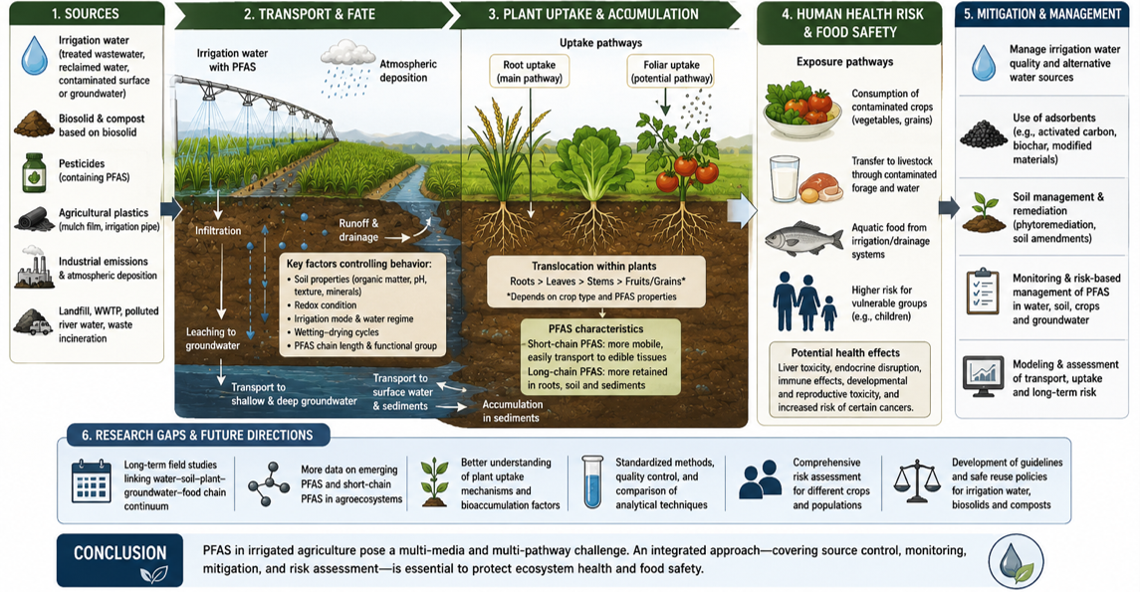
Per- and polyfluoroalkyl substances (PFAS) are persistent contaminants that are increasingly of concern in irrigation farming systems because they can enter the soil, water, plants, sediments, groundwater, and food chains. This review aims to synthesize sources, transportation, environmental fate, plant absorption, health risks, and PFAS mitigation strategies in agricultural agroecosystems. The literature was obtained from the Scopus database with the keyword "PFAS irrigation Agriculture" and produced 43 documents, consisting of 40 articles and 3 reviews. The results of the study show that the main sources of PFAS on agricultural land include polluted irrigation water, treated wastewater, reclaimed water, biosolids, biosolid-based compost, pesticides, agricultural plastics, atmospheric deposition, landfills, wastewater treatment plants, polluted river water, and industrial emissions. PFAS can move through infiltration, leaching, runoff, drainage, groundwater transport, and sediment accumulation. Short-chain PFAS tend to be more mobile and easily move into water and plant tissues, while long-chain PFAS are more strongly bound to soil, roots, and sediments. Some crops such as rice, soybeans, wheat, tomatoes, lettuce, turnips, and feed crops can accumulate PFAS through root uptake and, under certain conditions, foliar uptake. Health risks are mainly related to the consumption of agricultural products and animal food from polluted systems. Mitigation strategies include water source management, alternating irrigation, biochar, carbon adsorbents, soil remediation, validation of analytical methods, and transport modeling. This review emphasizes the need for a soil-water-crop-groundwater continuum approach for integrated PFAS management.
References
Anas, M., Altun, V., Khattak, W. A., Khan, A., ErcİŞLİ, S., Khan, K. A., & Hakki, E. E. 2026. Environmental geochemistry of emerging contaminants: impacts on agroecosystem function, food security, and human health. Environmental Geochemistry and Health, 48(3), 117. https://doi.org/10.1007/s10653-026-03007-z
Bao, J., Yu, W.-J., Liu, Y., Wang, X., Jin, Y.-H., & Dong, G.-H. 2019. Perfluoroalkyl substances in groundwater and home-produced vegetables and eggs around a fluorochemical industrial park in China. Ecotoxicology and Environmental Safety, 171, 199-205. https://doi.org/10.1016/j.ecoenv.2018.12.086
Baqar, M., Saleem, R., Zhao, M., Zhao, L., Cheng, Z., Chen, H., Yao, Y., & Sun, H. 2024. Combustion of high-calorific industrial waste in conventional brick kilns: An emerging source of PFAS emissions to agricultural soils. Science of The Total Environment, 906, 167612. https://doi.org/10.1016/j.scitotenv.2023.167612
Battisti, I., Trentin, A. R., Franzolin, E., Nicoletto, C., Masi, A., & Renella, G. 2024. Uptake and distribution of perfluoroalkyl substances by grafted tomato plants cultivated in a contaminated site in northern Italy. Science of The Total Environment, 915, 170032. https://doi.org/10.1016/j.scitotenv.2024.170032
Biswas, B., Joseph, A., Parveen, N., Ranjan, V. P., Goel, S., Mandal, J., & Srivastava, P. 2025. Contamination of per- and poly-fluoroalkyl substances in agricultural soils: A review. Journal of Environmental Management, 380, 124993. https://doi.org/10.1016/j.jenvman.2025.124993
Borthakur, A., Wang, M., He, M., Ascencio, K., Blotevogel, J., Adamson, D. T., Mahendra, S., & Mohanty, S. K. 2021. Perfluoroalkyl acids on suspended particles: Significant transport pathways in surface runoff, surface waters, and subsurface soils. Journal of Hazardous Materials, 417, 126159. https://doi.org/10.1016/j.jhazmat.2021.126159
Brown, J. B., Conder, J. M., Arblaster, J. A., & Higgins, C. P. 2020. Assessing Human Health Risks from Per- and Polyfluoroalkyl Substance (PFAS)-Impacted Vegetable Consumption: A Tiered Modeling Approach. Environmental Science & Technology, 54(23), 15202-15214. https://doi.org/10.1021/acs.est.0c03411
Chen, H., Chow, A. T., Williams, C. F., Wang, J., & Sun, W. 2025. Emerging Contaminants in Agroecosystems. Journal of Agricultural and Food Chemistry, 73(19), 11556-11558. https://doi.org/10.1021/acs.jafc.5c02505
Chen, X., Xu, D., Xiao, Y., Zuo, M., Zhou, J., Sun, X., Shan, G., & Zhu, L. 2024. Multimedia and Full-Life-Cycle Monitoring Discloses the Dynamic Accumulation Rules of PFAS and Underestimated Foliar Uptake in Wheat near a Fluorochemical Industrial Park. Environmental Science & Technology, 58(41), 18088-18097. https://doi.org/10.1021/acs.est.4c03525
Costello, M. C. S., & Lee, L. S. 2024. Sources, Fate, and Plant Uptake in Agricultural Systems of Per- and Polyfluoroalkyl Substances. Current Pollution Reports, 10(4), 799-819. https://doi.org/10.1007/s40726-020-00168-y
Dhore, R., & Murthy, G. S. 2021. Per/polyfluoroalkyl substances production, applications and environmental impacts. Bioresource Technology, 341, 125808. https://doi.org/10.1016/j.biortech.2021.125808
Eun, H., Yamazaki, E., Pan, Y., Taniyasu, S., Noborio, K., & Yamashita, N. 2022. Evaluating the Distribution of Perfluoroalkyl Substances in Rice Paddy Lysimeter with an Andosol. International Journal of Environmental Research and Public Health, 19(16), 10379. https://doi.org/10.3390/ijerph191610379
Gaines, L. G. T. 2023. Historical and current usage of per- and polyfluoroalkyl substances (PFAS): A literature review. American Journal of Industrial Medicine, 66(5), 353-378. https://doi.org/10.1002/ajim.23362
Glüge, J., Scheringer, M., Cousins, I. T., DeWitt, J. C., Goldenman, G., Herzke, D., Lohmann, R., Ng, C. A., Trier, X., & Wang, Z. 2020. An overview of the uses of per-and polyfluoroalkyl substances (PFAS). Environmental science: processes & impacts, 22(12), 2345-2373. https://doi.org/10.1039/D0EM00291G
Huang, S., Jiang, F., Dong, Q., Yu, J., Fan, K., Wang, Z., Hao, S., & Qiao, Y. 2025. The impact of climate change induced extreme weather events on microbial dynamics and public health: an in-depth review on water quality and ecosystem resilience. Frontiers in Environmental Science, 13, 1674490. https://doi.org/10.3389/fenvs.2025.1674490
Ismanto, A., Hadibarata, T., Wahyuningsih, C., Maslukah, L., Wijaya, Y. J., Safinatunnajah, N., & Widyani, A. P. 2026. Per- and polyfluoroalkyl substances (PFAS): persistence, toxicity, and emerging solutions. Bioprocess and Biosystems Engineering. https://doi.org/10.1007/s00449-026-03317-7
Johnson, G. R. 2022. PFAS in soil and groundwater following historical land application of biosolids. Water Research, 211, 118035. https://doi.org/10.1016/j.watres.2021.118035
Jones, O. A. H., Brindle, A., Sterjovski, M., Al-Mashari, S., Netherway, P., Lewis, P., Martin, J., & Currell, M. 2026. Occurrence and transport of per- and polyfluoroalkyl substances (PFAS) within a coastal groundwater aquifer. Journal of Contaminant Hydrology, 277, 104861. https://doi.org/10.1016/j.jconhyd.2026.104861
Kosiarski, K., Usner, C., & Preisendanz, H. E. 2025. From wastewater to feed: Understanding per- and polyfluoroalkyl substances occurrence in wastewater-irrigated crops. Journal of Environmental Quality, 54(1), 66-79. https://doi.org/10.1002/jeq2.20630
Levine, A. J., Bean, E. Z., Hinz, F. O., Wilson, P. C., & Reisinger, A. J. 2023. Leaching of select per-/poly-fluoroalkyl substances, pharmaceuticals, and hormones through soils amended with composted biosolids. Journal of Environmental Management, 343, 118185. https://doi.org/10.1016/j.jenvman.2023.118185
Li, B., Wang, H., Yu, P., Zou, P., Tan, D., & Jin, F. 2025. Distribution, uptake, and daily exposure of per- and polyfluoroalkyl substances in a paddy field: A growth cycle study. Journal of Hazardous Materials, 492, 138256. https://doi.org/10.1016/j.jhazmat.2025.138256
Li, Z., Hui, Y., Li, M., Li, H., & Liu, X. 2026. Effect of long-chain PFAS on the migration of short-chain PFAS: Adsorption mechanism and molecular-level analysis. Chemical Engineering Journal, 527, 171815. https://doi.org/10.1016/j.cej.2025.171815
Liao, S., Garza-Rubalcava, U., Abriola, L. M., Preisendanz, H. E., Lee, L. S., & Pennell, K. D. 2025. Simulating PFAS transport in effluent-irrigated farmland using PRZM5, LEACHM, and HYDRUS-1D models. Journal of Environmental Quality, 54(1), 54-65. https://doi.org/10.1002/jeq2.20639
Madeira, C. L., Acayaba, R. D. A., Santos, V. S., Villa, J. E. L., Jacinto-Hernández, C., Azevedo, J. A. T., Elias, V. O., & Montagner, C. C. 2023. Uncovering the impact of agricultural activities and urbanization on rivers from the Piracicaba, Capivari, and Jundiaí basin in São Paulo, Brazil: A survey of pesticides, hormones, pharmaceuticals, industrial chemicals, and PFAS. Chemosphere, 341, 139954. https://doi.org/10.1016/j.chemosphere.2023.139954
McDonough, A. M., Bird, A. W., Freeman, L. M., Luciani, M. A., & Todd, A. K. 2021. Fate and budget of poly- and perfluoroalkyl substances in three common garden plants after experimental additions with contaminated river water. Environmental Pollution, 285, 117115. https://doi.org/10.1016/j.envpol.2021.117115
Mroczko, O., Preisendanz, H. E., Wilson, C., Mashtare, M. L., Elliott, H. A., Veith, T. L., Soder, K. J., & Watson, J. E. 2022. Spatiotemporal patterns of PFAS in water and crop tissue at a beneficial wastewater reuse site in central Pennsylvania. Journal of Environmental Quality, 51(6), 1282-1297. https://doi.org/10.1002/jeq2.20408
Omagamre, E. W., Bala, S. Z., Zebelo, S. A., & Pitula, J. S. 2025. Field-informed simulation of perfluoroalkyl substances-contaminated irrigation water alters soybean phenotype and root transcriptome. Science of The Total Environment, 1001, 180545. https://doi.org/10.1016/j.scitotenv.2025.180545
Papes, B., Shimabuku, K., Garbowski, M., & Kennedy, A. 2025. Per- and Polyfluoroalkyl Substances Removal Using Carbonaceous Adsorbents in a Brackish Water Circular Economy. Environmental Engineering Science, 42(7), 304-313. https://doi.org/10.1089/ees.2025.0028
Pepper, I. L., Brusseau, M. L., Prevatt, F. J., & Escobar, B. A. 2021. Incidence of Pfas in soil following long-term application of class B biosolids. Science of The Total Environment, 793, 148449. https://doi.org/10.1016/j.scitotenv.2021.148449
Preisendanz, H. E., Li, H., Mashtare, M., & Mina, O. 2025. PFAS in agroecosystems: Sources, impacts, and opportunities for mitigating risks to human and ecosystem health. Journal of Environmental Quality, 54(1), 1-5. https://doi.org/10.1002/jeq2.20670
Ramos, P., & Ashworth, D. J. 2024. Per- and poly-fluoroalkyl substances in agricultural contexts and mitigation of their impacts using biochar: A review. Science of The Total Environment, 927, 172275. https://doi.org/10.1016/j.scitotenv.2024.172275
Renella, G., Carletti, P., & Masi, A. 2025. Sustainable Management of Poly- and Perfluoroalkyl Substances (PFASs)-Contaminated Areas: Tackling a Wicked Environmental Problem. Sustainability, 17(2), 510. https://doi.org/10.3390/su17020510
Seelig, A. H., Junghans, V., Reemtsma, T., & Zahn, D. 2025. Plant Uptake of Persistent and Mobile Chemicals in Rocket (Eruca sativa)─A Greenhouse Study on Agricultural Wastewater Reuse. Environmental Science & Technology, 59(18), 9265-9274. https://doi.org/10.1021/acs.est.5c02379
Shi, Q., Cao, M., Xiong, Y., Kaur, P., Fu, Q., Smith, A., Yates, R., & Gan, J. 2024. Alternating water sources to minimize contaminant accumulation in food plants from treated wastewater irrigation. Water Research, 255, 121504. https://doi.org/10.1016/j.watres.2024.121504
Shi, Q., Shen, D., Yates, R., Chou, C., Barajas, A., Zhang, J., Schlenk, D., & Gan, J. 2025. Safe Reuse of Treated Wastewater: Accumulation of Contaminants of Emerging Concern in Field-Grown Vegetables under Different Irrigation Schemes. Environmental Science & Technology, 59(12), 6261-6271. https://doi.org/10.1021/acs.est.4c13666
Shigei, M., Ahrens, L., Hazaymeh, A., & Dalahmeh, S. S. 2020. Per- and polyfluoroalkyl substances in water and soil in wastewater-irrigated farmland in Jordan. Science of The Total Environment, 716, 137057. https://doi.org/10.1016/j.scitotenv.2020.137057
Simonetti, F., Ciuccoli, N., Ankan, A., Mancini, M., Castellani, M., Sgroi, M., Fatone, F., & Migliorati, V. 2026. A Bayesian probabilistic framework for next-generation chemical risk assessment: The case of PFOA in crops irrigated with treated wastewater. Water Research, 290, 125133. https://doi.org/10.1016/j.watres.2025.125133
Song, C., Gu, Q., Zhang, D., Zhou, D., & Cui, X. 2024. Prediction of PFAS bioaccumulation in different plant tissues with machine learning models based on molecular fingerprints. Science of The Total Environment, 950, 175091. https://doi.org/10.1016/j.scitotenv.2024.175091
Szabo, D., Coggan, T. L., Robson, T. C., Currell, M., & Clarke, B. O. 2018. Investigating recycled water use as a diffuse source of per- and polyfluoroalkyl substances (PFASs) to groundwater in Melbourne, Australia. Science of The Total Environment, 644, 1409-1417. https://doi.org/10.1016/j.scitotenv.2018.07.048
Verley, J. C., McLennon, E., Rein, K. S., Dikgang, J., & Kankarla, V. 2025. Current trends and patterns of PFAS in agroecosystems and environment: A review. Journal of Environmental Quality, 54(1), 80-107. https://doi.org/10.1002/jeq2.20607
Wang, L., Hou, J., Han, B., Wang, J., Chen, L., & Liu, W. 2026. From greenhouses to open fields: Multidimensional drivers of per- and polyfluoroalkyl substance (PFAS) residues in farmland soils across China. Environmental Research, 294, 123838. https://doi.org/10.1016/j.envres.2026.123838
Wang, W., Rhodes, G., Ge, J., Yu, X., & Li, H. 2020. Uptake and accumulation of per- and polyfluoroalkyl substances in plants. Chemosphere, 261, 127584. https://doi.org/10.1016/j.chemosphere.2020.127584
Wu, J., Li, L., Chen, M., Liu, M., & Tu, W. 2024. Modulation of irrigation-induced microbial nitrogen‑iron redox to per- and polyfluoroalkyl substances' water-soil interface release in paddy fields: Activation or immobilization? Science of The Total Environment, 956, 177377. https://doi.org/10.1016/j.scitotenv.2024.177377
Wu, J., Li, L., Chen, M., Zeng, M., Huang, X., & Tu, W. 2025. Compensatory release of per- and polyfluoroalkyl substances at the soil–water interface in paddy fields under post-drought rehydration. Journal of Hazardous Materials, 500, 140412. https://doi.org/10.1016/j.jhazmat.2025.140412
Xing, Z., Wang, G., Liu, S., Chen, H., Dong, X., Wang, H., & Liu, Y. 2024. Legacy and emerging per- and polyfluoroalkyl substances (PFASs) in agricultural soils affected by fluorochemical manufacturing facilities, North China: Occurrence, region-specific distribution, substitution trend and source appointment. Journal of Hazardous Materials, 474, 134770. https://doi.org/10.1016/j.jhazmat.2024.134770
Xingchun, J., Wei, Z., Jing, P., Guohui, L., Dian, C., Zhaohe, Z., & Yiran, Z. 2023. The occurrence, spatial distribution, and well-depth dependence of PFASs in groundwater from a reclaimed water irrigation area. Science of The Total Environment, 901, 165904. https://doi.org/10.1016/j.scitotenv.2023.165904
Yamashita, N., Yamazaki, E., Taniyasu, S., Hanari, N., & Yeung, L. W. Y. 2024. Biochar from paddy field - A solution to reduce PFAS pollution in the environment. Chemosphere, 364, 143073. https://doi.org/10.1016/j.chemosphere.2024.143073
Zhang, H., Shui, J., Li, C., Ma, J., He, F., & Zhao, D. 2024. Diversity, composition, and assembly processes of bacterial communities within per- and polyfluoroalkyl substances (PFAS)-contained urban lake sediments. Science of The Total Environment, 957, 177625. https://doi.org/10.1016/j.scitotenv.2024.177625
Zhang, M., Wang, P., Lu, Y., Shi, Y., Wang, C., Sun, B., Li, X., Song, S., Yu, M., Zhao, J., Du, D., Qin, W., Wang, T., Han, G., Liu, Z., Baninla, Y., & Zhang, A. 2021. Transport and environmental risks of perfluoroalkyl acids in a large irrigation and drainage system for agricultural production. Environment International, 157, 106856. https://doi.org/10.1016/j.envint.2021.106856
Zheng, Y.-H., Carter, E., Zou, S., Williams, C. F., Chow, A. T., & Chen, H. 2025. Using syringe filtration after lab-scale adsorption processes potentially overestimates PFAS adsorption removal efficiency from non-conventional irrigation water. Journal of Environmental Quality, 54(1), 20-30. https://doi.org/10.1002/jeq2.20640
Additional Files
Published
How to Cite
Issue
Section
License
Copyright (c) 2026 Environmental and Agriculture Management

This work is licensed under a Creative Commons Attribution-NonCommercial-ShareAlike 4.0 International License.
Authors retain copyright and grant the journal right of first publication with the work simultaneously licensed under a Creative Commons Attribution License that allows others to share the work with an acknowledgement of the work's authorship and initial publication in this journal.
Authors are able to enter into separate, additional contractual arrangements for the non-exclusive distribution of the journal's published version of the work (e.g., post it to an institutional repository or publish it in a book), with an acknowledgement of its initial publication in this journal.
Authors are permitted and encouraged to post their work online (e.g., in institutional repositories or on their website) prior to and during the submission process, as it can lead to productive exchanges, as well as earlier and greater citation of published work