Natural materials as sustainable adsorbents for per- and polyfluoroalkyl (PFAS) substances remediation in real water systems
DOI:
https://doi.org/10.31102/eam.3.1.1-22Keywords:
PFAS, real water, treatment, removal, mechanismAbstract
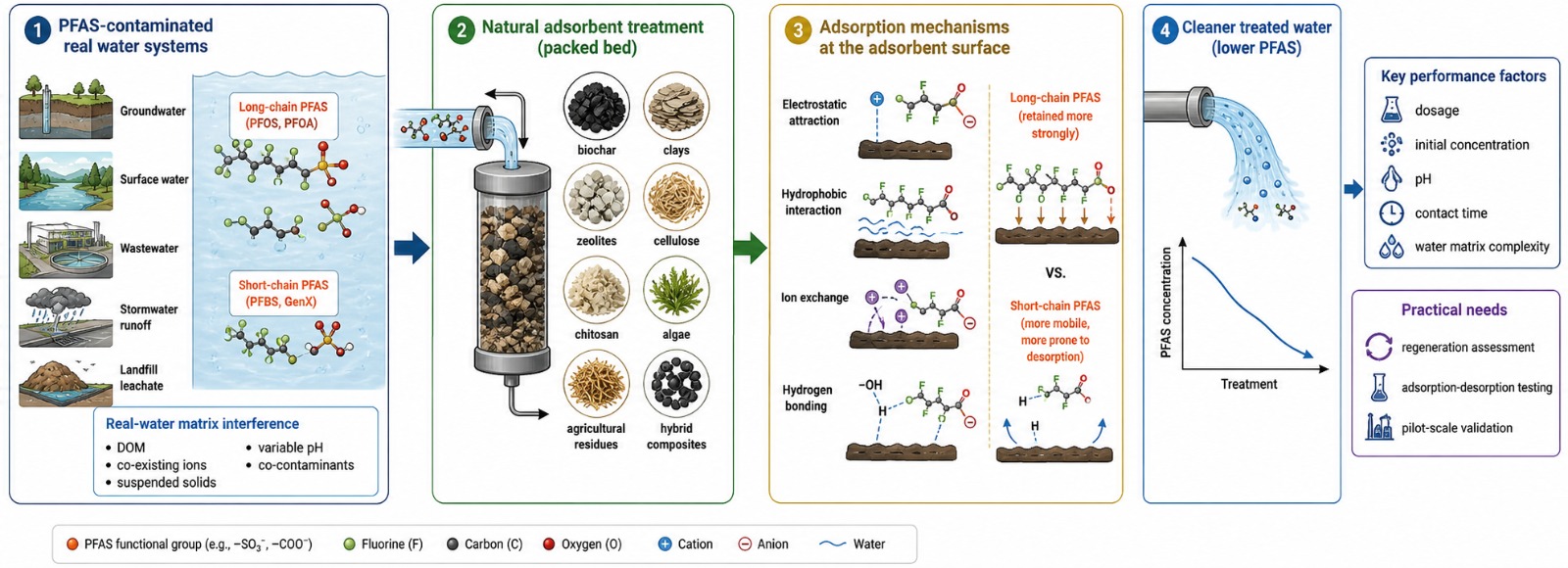
The persistence of per- and polyfluoroalkyl substances (PFAS) in aquatic environments continues to pose significant challenges for water treatment, particularly under real-world conditions where the presence of co-contaminants and matrix complexity substantially reduce removal efficiency. This review provides a comprehensive evaluation of natural adsorbents for PFAS remediation, emphasizing adsorption performance in relation to key operational parameters such as adsorbent dosage, initial PFAS concentration, pH, contact time, and removal efficiency. Natural adsorbents such as biochar, clays, zeolites, and agricultural residues have demonstrated promising adsorption capacities, primarily determined by their surface functional groups and porous structures. Adsorption kinetics reported in previous studies were predominantly described by pseudo-second-order (PSO) models, suggesting that chemisorption is the main controlling mechanism. Desorption analyses further revealed that PFAS adsorbent interactions were not always stable. Elevated ionic strength and the presence of dissolved organic matter frequently promoted PFAS release, thereby raising concerns about adsorbent reusability and long-term stability. Notably, long-chain PFAS generally formed strong monolayer adsorption patterns consistent with Langmuir behavior, whereas short-chain PFAS exhibited more heterogeneous and reversible adsorption trends, as predicted by Freundlich models. This review underscores both the potential and the limitations of natural adsorbents for PFAS removal under environmentally relevant water matrices. While adsorption has proven effective in many laboratory-scale studies, desorption and regeneration remain critical barriers to practical application. To address these issues, future research should prioritize surface modification strategies, the development of hybrid composite materials, and pilot-scale investigations to validate long-term performance and field applicability.
References
Abdelhamid, H. N. (2025). Degradable Biopolymer-Based Nanocomposites in Water Treatment and Air Purification: A Review. ACS Applied Polymer Materials, 7(11), 6576-6596. doi:10.1021/acsapm.5c00600
Adamson, D. T., Newell, C. J., Kulkarni, P., & Stroo, H. (2025). PFAS Monitored Retention: A Framework for Managing PFAS-Contaminated Groundwater Sites. Groundwater Monitoring & Remediation, 45(3), 37-49. doi:https://doi.org/10.1111/gwmr.70001
Amirfakhri, S. J., Zobel, B., Lilla, M. K., Tomaszewski, C., & Stellpflug, O. (2025). Enhanced PFBS adsorption via silver-impregnated activated carbon: Mechanistic insights and Thermodynamic analysis. Chemosphere, 375, 144257. doi:https://doi.org/10.1016/j.chemosphere.2025.144257
Arnold, A. M., Singh, J., & Sydlik, S. A. (2025). The Role and Future of Functional Graphenic Materials in Biomedical and Human Health Applications. Biomacromolecules, 26(4), 2015-2042. doi:https://doi.org/10.1021/acs.biomac.4c01431
Beyioku, O. E., Gilboa, A., & Ronen, A. (2025). PFAS adsorption and desorption on functionalized surfaces: A QCM and kinetic modeling approach. Separation and Purification Technology, 372, 133457. doi:https://doi.org/10.1016/j.seppur.2025.133457
Biswas, S., & Das, A. (2021). Recent Developments in Polymeric Assemblies and Functional Materials by Halogen Bonding. ChemNanoMat, 7(7), 748-772. doi:https://doi.org/10.1002/cnma.202100161
Deng, S., Zheng, Y. Q., Xu, F. J., Wang, B., Huang, J., & Yu, G. (2012). Highly efficient sorption of perfluorooctane sulfonate and perfluorooctanoate on a quaternized cotton prepared by atom transfer radical polymerization. Chemical Engineering Journal, 193-194, 154-160. doi:https://doi.org/10.1016/j.cej.2012.04.005
Dong, Q., Min, X., Huo, J., & Wang, Y. (2021). Efficient sorption of perfluoroalkyl acids by ionic liquid-modified natural clay. Chemical Engineering Journal Advances, 7, 100135. doi:https://doi.org/10.1016/j.ceja.2021.100135
Dong, Q., Min, X., Zhang, W., Zhao, Y., & Wang, Y. (2024). Removal of perfluoroalkyl acids and precursors with silylated clay: Efficient adsorption and enhanced reuse. Journal of Hazardous Materials, 480, 136202. doi:https://doi.org/10.1016/j.jhazmat.2024.136202
Dudarko, O., Budnyak, T., Tkachenko, O., Agback, T., Agback, P., Bonnet, B., . . . Seisenbaeva, G. (2024). Removal of Poly- and Perfluoroalkyl Substances from Natural and Wastewater by Tailored Silica-Based Adsorbents. ACS ES&T Water, 4(4), 1303-1314. doi:10.1021/acsestwater.3c00408
Ehsan, M. N., Riza, M., Pervez, M. N., & Liang, Y. (2025). Source identification and distribution of per- and polyfluoroalkyl substances (PFAS) in the freshwater environment of USA. International Journal of Environmental Science and Technology, 22(3), 2021-2046. doi:https://doi.org/10.1007/s13762-024-05851-x
Fagbayigbo, B. O., Opeolu, B. O., Fatoki, O. S., Akenga, T. A., & Olatunji, O. S. (2017). Removal of PFOA and PFOS from aqueous solutions using activated carbon produced from Vitis vinifera leaf litter. Environmental Science and Pollution Research, 24(14), 13107-13120. doi:https://doi.org/10.1007/s11356-017-8912-x
Fan, X., Li, X., Li, T., Shao, B., Niu, S., Fan, W., . . . Dong, Z. (2025). Binding of per- and polyfluoroalkyl substances with liver and serum proteins in rats: implications for physiologically based pharmacokinetic modelling. Environment International, 201, 109591. doi:https://doi.org/10.1016/j.envint.2025.109591
Gagliano, E., Falciglia, P. P., Zaker, Y., Birben, N. C., Karanfil, T., & Roccaro, P. (2023). State of the research on regeneration and reactivation techniques for per- and polyfluoroalkyl substances (PFAS)-laden granular activated carbons (GACs). Current Opinion in Chemical Engineering, 42, 100955. doi:https://doi.org/10.1016/j.coche.2023.100955
Gaines, L. G. T. (2023). Historical and current usage of per- and polyfluoroalkyl substances (PFAS): A literature review. American Journal of Industrial Medicine, 66(5), 353-378. doi:https://doi.org/10.1002/ajim.23362
Gonçalves, J. O., Leones, A. R., de Farias, B. S., da Silva, M. D., Jaeschke, D. P., Fernandes, S. S., . . . Pinto, L. A. (2025). A Comprehensive Review of Agricultural Residue-Derived Bioadsorbents for Emerging Contaminant Removal. Water, 17(14). doi:https://doi.org/10.3390/w17142141
Guo, W., Huo, S., Feng, J., & Lu, X. (2017). Adsorption of perfluorooctane sulfonate (PFOS) on corn straw-derived biochar prepared at different pyrolytic temperatures. Journal of the Taiwan Institute of Chemical Engineers, 78, 265-271. doi:https://doi.org/10.1016/j.jtice.2017.06.013
Hernandez, E. T., Koo, B., Sofen, L. E., Amin, R., Togashi, R. K., Lall, A. I., . . . Francis, M. B. (2022). Proteins as adsorbents for PFAS removal from water. Environmental Science: Water Research & Technology, 8(6), 1188-1194. doi:https://doi.org/10.1039/D1EW00501D
Huang, Q., Song, S., Chen, Z., Hu, B., Chen, J., & Wang, X. (2019). Biochar-based materials and their applications in removal of organic contaminants from wastewater: state-of-the-art review. Biochar, 1(1), 45-73. doi:ttps://doi.org/10.1007/s42773-019-00006-5
Iqbal, D., Iqbal, W., Ullah, R., Zhao, R., Iqbal, N., & Ning, X. (2025). Cuprammonium cellulose nanomembranes for sustainable antibiotic removal from water. Journal of Water Process Engineering, 70, 107076. doi:https://doi.org/10.1016/j.jwpe.2025.107076
Jahan, I., Tani, E. A., Patel, H. V., Zhao, R., & Zhang, L. (2025). Polyaniline-Coated Electrospun Polyacrylonitrile Nanofibers for Effective Short-Chain PFAS (GenX) Removal from Water. Fibers, 13(4), 42. doi:https://doi.org/10.3390/fib13040042
Kang, S. B., Wang, Z., Zhang, W., Kim, K.-Y., & Won, S. W. (2023). Removal of short- and long-chain PFAS from aquatic systems using electrostatic attraction of polyethylenimine-polyvinyl chloride electrospun nanofiber adsorbent. Separation and Purification Technology, 326, 124853. doi:https://doi.org/10.1016/j.seppur.2023.124853
Kang, Y., Song, F., Lin, J., Liu, H., Wang, N., & Zhu, L. (2025). Enhanced selective adsorption of perfluoroalkyl substances through an integration of quaternized cellulose nonwoven and micro-nano-bubbles. Separation and Purification Technology, 365, 132598. doi:https://doi.org/10.1016/j.seppur.2025.132598
Kasula, M., Ortbal, S., Kebede, M. M., Terry, L., & Esfahani, M. R. (2025). Evaluating Biofiltration Pretreatment and NOM-PFAS Dynamics in PFAS Removal by Nanofiltration Membranes. ACS ES&T Water, 5(7), 3628-3642. doi:https://doi.org/10.1021/acsestwater.4c01032
Kebria, M. R. S., Bono, L., Khoshhal Salestan, S., Armirotti, A., Carzino, R., Athanassiou, A., & Fragouli, D. (2023). Efficient removal of perfluorobutanesulfonic acid from water through a chitosan/polyethyleneimine xerogel. Chemical Engineering Journal, 466, 143236. doi:https://doi.org/10.1016/j.cej.2023.143236
Khan, M. I., Shanableh, A., Elboughdiri, N., Lashari, M. H., Manzoor, S., Shahida, S., . . . ur Rehman, A. (2022). Adsorption of Methyl Orange from an Aqueous Solution onto a BPPO-Based Anion Exchange Membrane. ACS Omega, 7(30), 26788-26799. doi:https://doi.org/10.1021/acsomega.2c03148
Khazaee, M., Christie, E., Cheng, W., Michalsen, M., Field, J., & Ng, C. (2021). Perfluoroalkyl Acid Binding with Peroxisome Proliferator-Activated Receptors α, γ, and δ, and Fatty Acid Binding Proteins by Equilibrium Dialysis with a Comparison of Methods. Toxics, 9(3). doi:https://doi.org/10.3390/toxics9030045
Kim, G., Mengesha, D. N., & Choi, Y. (2024). Adsorption dynamics of per- and polyfluoroalkyl substances (PFAS) on activated carbon: Interplay of surface chemistry and PFAS structural properties. Separation and Purification Technology, 349, 127851. doi:https://doi.org/10.1016/j.seppur.2024.127851
Kim, H.-H., Koster van Groos, P. G., Zhao, Y., & Pham, A. L.-T. (2024). Removal of PFAS by hydrotalcite: Adsorption mechanisms, effect of adsorbent aging, and thermal regeneration. Water Research, 260, 121925. doi:https://doi.org/10.1016/j.watres.2024.121925
Kinoti, I. K., Karanja, E. M., Nthiga, E. W., M’thiruaine, C. M., & Marangu, J. M. (2022). Review of Clay-Based Nanocomposites as Adsorbents
for the Removal of Heavy Metals. Journal of Chemistry, 2022(1), 7504626. doi:https://doi.org/10.1155/2022/7504626
Lenka, S. P., Kah, M., Chen, J. L. Y., Tiban-Anrango, B. A., & Padhye, L. P. (2024). Adsorption mechanisms of short-chain and ultrashort-chain PFAS on anion exchange resins and activated carbon. Environmental Science: Water Research & Technology, 10(5), 1280-1293. doi:https://doi.org/10.1039/D3EW00959A
Lewis, A. J., Yun, X., Lewis, M. G., McKenzie, E. R., Spooner, D. E., Kurz, M. J., . . . Sales, C. M. (2023). Impacts of divalent cations (Mg2+ and Ca2+) on PFAS bioaccumulation in freshwater macroinvertebrates representing different foraging modes. Environmental Pollution, 331, 121938. doi:https://doi.org/10.1016/j.envpol.2023.121938
Liu, F., Pignatello, J. J., Sun, R., Guan, X., & Xiao, F. (2024). A Comprehensive Review of Novel Adsorbents for Per- and Polyfluoroalkyl Substances in Water. ACS ES&T Water, 4(4), 1191-1205. doi:https://doi.org/10.1021/acsestwater.3c00569
Liu, G., Li, C., Stewart, B. A., Liu, L., Zhang, M., Yang, M., & Lin, K. (2020). Enhanced thermal activation of peroxymonosulfate by activated carbon for efficient removal of perfluorooctanoic acid. Chemical Engineering Journal, 399, 125722. doi:https://doi.org/10.1016/j.cej.2020.125722
Liu, X., Wang, Y., Luo, C., Zhang, Z., Sun, H., Xu, C., & Chen, H. (2024). Hydrothermal Synthesis of β-NiS Nanoparticles and Their Applications in High-Performance Hybrid Supercapacitors. Nanomaterials, 14(15). doi:https://doi.org/10.3390/nano14151299
Mantripragada, S., Deng, D., & Zhang, L. (2023). Algae-Enhanced Electrospun Polyacrylonitrile Nanofibrous Membrane for High-Performance Short-Chain PFAS Remediation from Water. Nanomaterials, 13(19), 2646. doi:https://doi.org/10.3390/nano13192646
Mantripragada, S., Dong, M., & Zhang, L. (2023). Sustainable filter/adsorbent materials from cellulose-based electrospun nanofibrous membranes with soy protein coating for high-efficiency GenX fluorocarbon remediation from water. Cellulose, 30(11), 7063-7078. doi:10.1007/s10570-023-05304-7
Meng, P., Fang, X., Maimaiti, A., Yu, G., & Deng, S. (2019). Efficient removal of perfluorinated compounds from water using a regenerable magnetic activated carbon. Chemosphere, 224, 187-194. doi:https://doi.org/10.1016/j.chemosphere.2019.02.132
Mer, K., Arachchilage, P., Tao, W., & Egiebor, N. O. (2024). Activation of sawdust biochar with water and wastewater treatment residuals for sorption of perfluorooctanesulfonic acid in water. Chemosphere, 358, 142160. doi:https://doi.org/10.1016/j.chemosphere.2024.142160
Militao, I. M., Roddick, F., Fan, L., Zepeda, L. C., Parthasarathy, R., & Bergamasco, R. (2023). PFAS removal from water by adsorption with alginate-encapsulated plant albumin and rice straw-derived biochar. Journal of Water Process Engineering, 53, 103616. doi:https://doi.org/10.1016/j.jwpe.2023.103616
Niu, B., Yang, S., Li, Y., Zang, K., Sun, C., Yu, M., . . . Zheng, Y. (2020). Regenerable magnetic carbonized Calotropis gigantea fiber for hydrophobic-driven fast removal of perfluoroalkyl pollutants. Cellulose, 27(10), 5893-5905. doi:https://doi.org/10.1007/s10570-020-03192-9
Omo-Okoro, P. N., Curtis, C. J., Karásková, P., Melymuk, L., Oyewo, O. A., & Okonkwo, J. O. (2020). Kinetics, Isotherm, and Thermodynamic Studies of the Adsorption Mechanism of PFOS and PFOA Using Inactivated and Chemically Activated Maize Tassel. Water, Air, & Soil Pollution, 231(9), 485. doi:https://doi.org/10.1007/s11270-020-04852-z
Panieri, E., Baralic, K., Djukic-Cosic, D., Buha Djordjevic, A., & Saso, L. (2022). PFAS Molecules: A Major Concern for the Human Health and the Environment. Toxics, 10(2). doi:https://doi.org/10.3390/toxics10020044
Pazol, J., Tong, X., Doerk, G. S., Bracho, D., Bello, S. A., Díaz-Fuentes, L., & Nicolau, E. (2024). Insights into Probing the Effect of Molecular Weight of Poly(carboxybetaine methacrylate) on the Performance of Forward Osmosis Desalination. ACS Applied Engineering Materials, 2(11), 2675-2688. doi:https://doi.org/10.1021/acsaenm.4c00566
Pervez, M. N., Jiang, T., Mahato, J. K., Ilango, A. K., Kumaran, Y., Zuo, Y., . . . Liang, Y. (2024). Surface Modification of Graphene Oxide for Fast Removal of Per- and Polyfluoroalkyl Substances (PFAS) Mixtures from River Water. ACS ES&T Water, 4(7), 2968-2980. doi:https://doi.org/10.1021/acsestwater.4c00187
Pimentel, C. H., Freire, M. S., Gómez-Díaz, D., & González-Álvarez, J. (2023). Removal of wood dyes from aqueous solutions by sorption on untreated pine (Pinus radiata) sawdust. Cellulose, 30(7), 4587-4608. doi:https://doi.org/10.1007/s10570-023-05145-4
Pranić, M., Carlucci, L., van der Wal, A., & Dykstra, J. E. (2025). Kinetic and isotherm study for the adsorption of per- and polyfluoroalkyl substances (PFAS) on activated carbon in the low ng/L range. Chemosphere, 370, 143889. doi:https://doi.org/10.1016/j.chemosphere.2024.143889
Ray, J. R., Shabtai, I. A., Teixidó, M., Mishael, Y. G., & Sedlak, D. L. (2019). Polymer-clay composite geomedia for sorptive removal of trace organic compounds and metals in urban stormwater. Water Research, 157, 454-462. doi:https://doi.org/10.1016/j.watres.2019.03.097
Sim, D., Byun, S., Lee, Y. S., Kim, J.-O., Nam, S. Y., An, A. K., & Jeong, S. (2024). Amplified efficacy of short-chain perfluoroalkyl substances removal with nanofiltration-magnetic activated carbon integration. Journal of Water Process Engineering, 64, 105585. doi:https://doi.org/10.1016/j.jwpe.2024.105585
Tang, C. Y., Shiang Fu, Q., Gao, D., Criddle, C. S., & Leckie, J. O. (2010). Effect of solution chemistry on the adsorption of perfluorooctane sulfonate onto mineral surfaces. Water Research, 44(8), 2654-2662. doi:https://doi.org/10.1016/j.watres.2010.01.038
Xing, D. Y., Chen, Y., Zhu, J., & Liu, T. (2020). Fabrication of hydrolytically stable magnetic core-shell aminosilane nanocomposite for the adsorption of PFOS and PFOA. Chemosphere, 251, 126384. doi:https://doi.org/10.1016/j.chemosphere.2020.126384
Yang, A., Ching, C., Easler, M., Helbling, D. E., & Dichtel, W. R. (2020). Cyclodextrin Polymers with Nitrogen-Containing Tripodal Crosslinkers for Efficient PFAS Adsorption. ACS Materials Letters, 2(9), 1240-1245. doi:https://doi.org/10.1021/acsmaterialslett.0c00240
Zhang, Q., Deng, S., Yu, G., & Huang, J. (2011). Removal of perfluorooctane sulfonate from aqueous solution by crosslinked chitosan beads: Sorption kinetics and uptake mechanism. Bioresource Technology, 102(3), 2265-2271. doi:https://doi.org/10.1016/j.biortech.2010.10.040
Zhang, W., Cao, H., & Liang, Y. (2021). Degradation by hydrothermal liquefaction of fluoroalkylether compounds accumulated in cattails (Typha latifolia). Journal of Environmental Chemical Engineering, 9(4), 105363. doi:https://doi.org/10.1016/j.jece.2021.105363
Zhang, W., Tran, N., & Liang, Y. (2022). Uptake of per- and polyfluoroalkyl substances (PFAS) by soybean across two generations. Journal of Hazardous Materials Advances, 8, 100170. doi:https://doi.org/10.1016/j.hazadv.2022.100170
Additional Files
Published
How to Cite
Issue
Section
License
Copyright (c) 2026 Environmental and Agriculture Management

This work is licensed under a Creative Commons Attribution-NonCommercial-ShareAlike 4.0 International License.
Authors retain copyright and grant the journal right of first publication with the work simultaneously licensed under a Creative Commons Attribution License that allows others to share the work with an acknowledgement of the work's authorship and initial publication in this journal.
Authors are able to enter into separate, additional contractual arrangements for the non-exclusive distribution of the journal's published version of the work (e.g., post it to an institutional repository or publish it in a book), with an acknowledgement of its initial publication in this journal.
Authors are permitted and encouraged to post their work online (e.g., in institutional repositories or on their website) prior to and during the submission process, as it can lead to productive exchanges, as well as earlier and greater citation of published work