Adding Value to Used Cooking Oil: Coffee-Scented Candle Innovation as a Creative Economy Product by the Margorejo Urban Village PKK Women's Group
DOI:
https://doi.org/10.31102/bajhrah.v3i2.4205Abstract
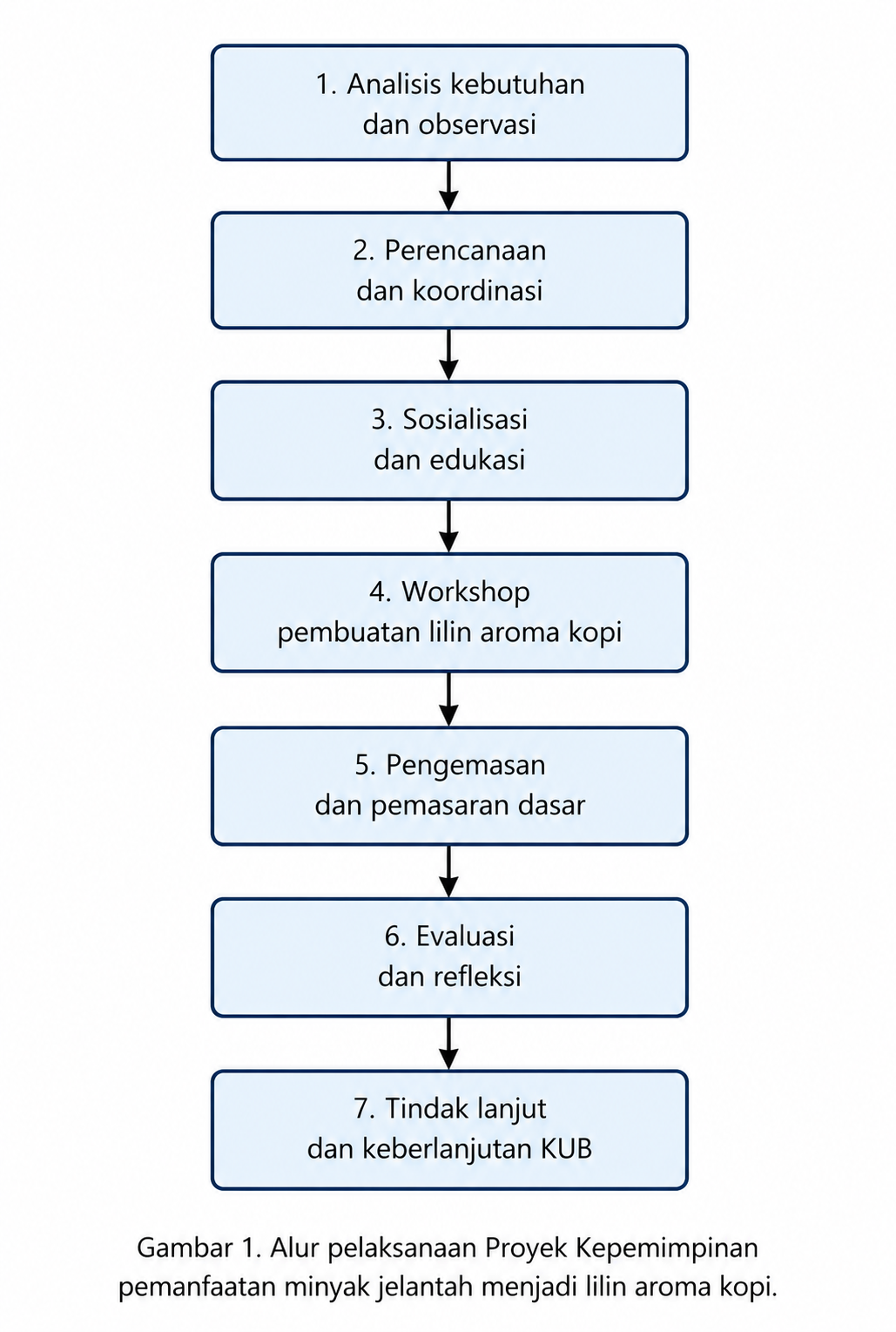
Waste cooking oil is a household waste that is often discarded directly into the environment, despite its potential to be reused as a non-food raw material. This community service project aimed to increase the understanding and practical skills of women members of the Family Welfare Empowerment (PKK) group in Margorejo Village in utilizing waste cooking oil to produce coffee-scented candles, while introducing basic concepts of product packaging, marketing, and household economic opportunities. The activity used a participatory community empowerment approach combined with experiential learning. The participants were members of the Margorejo Village PKK group, with 25 members in the partner group and 10 participants directly involved in the training. The activities consisted of needs analysis and observation, planning and coordination, socialization and education, a coffee-scented candle production workshop, packaging and basic marketing, evaluation and reflection, and follow-up for sustainability. The production process involved filtering and treating waste cooking oil with activated charcoal, mixing it with palm wax, adding ground coffee and coffee essence, installing the wick, and molding the candle. The results showed qualitatively that participants gained a better understanding of the potential value of waste cooking oil, acquired basic skills in producing coffee-scented candles, and were introduced to product packaging, basic production cost calculation, and digital marketing. The project also provided leadership learning experiences for PPG students through facilitation, coordination, problem solving, and reflection. The activity demonstrates that waste cooking oil can become an entry point for integrating environmental awareness, community empowerment, creative economic skills, and collaborative leadership. Further development requires product quality testing, more accurate cost recording, and a sustainable community-based production and marketing system.
References
Aini, D. N., Arisanti, D. W., Fitri, H. M., & Safitri, L. R. (2020). Pemanfaatan minyak jelantah untuk bahan baku produk lilin ramah lingkungan dan menambah penghasilan rumah tangga di Kota Batu. Warta Pengabdian, 14(4), 253–262. https://doi.org/10.19184/wrtp.v14i4.18539
Fitri, D. R., Fajar, I. R. F., & Komarudin, D. (2023). Perbandingan basis lilin palm wax dan paraffin wax terhadap sifat fisik dan daya tolak nyamuk lilin aromaterapi minyak kulit jeruk purut sebagai repellent. IONTech, 4(2), 44–54. https://doi.org/10.62702/ion.v4i2.92
Freire, P. (1970). Pedagogy of the oppressed. Continuum.
Kurniasih, T. R., Sari, D. P., Maeshofa, I., Anggraini, C., Harefa, R. M. S., & Sitompul, L. M. (2024). Perbandingan sifat fisik sediaan lilin aromaterapi kopi Robusta (Coffea canephora) dan kopi Arabika (Coffea arabica). Jurnal Riset Kefarmasian Indonesia, 6(2), 207–219.
Mufriantie, F., Ibrahim, J. T., & Amir, N. O. (2024). Pelatihan pembuatan lilin aromaterapi berbahan minyak jelantah di Kelompok PKK Kendalsari Tulusrejo Lowokwaru Kota Malang. PengabdianMu: Jurnal Ilmiah Pengabdian kepada Masyarakat, 9(3), 530–537. https://doi.org/10.33084/pengabdianmu.v9i3.6373