Forage-based livestock systems, insectivorous birds, and veterinary ecology: integrative review
DOI:
https://doi.org/10.31102/eam.3.1.23-46Keywords:
veterinary ecology, forage-based livestock systems, insectivorous birds, climate-smart livestock systemsAbstract
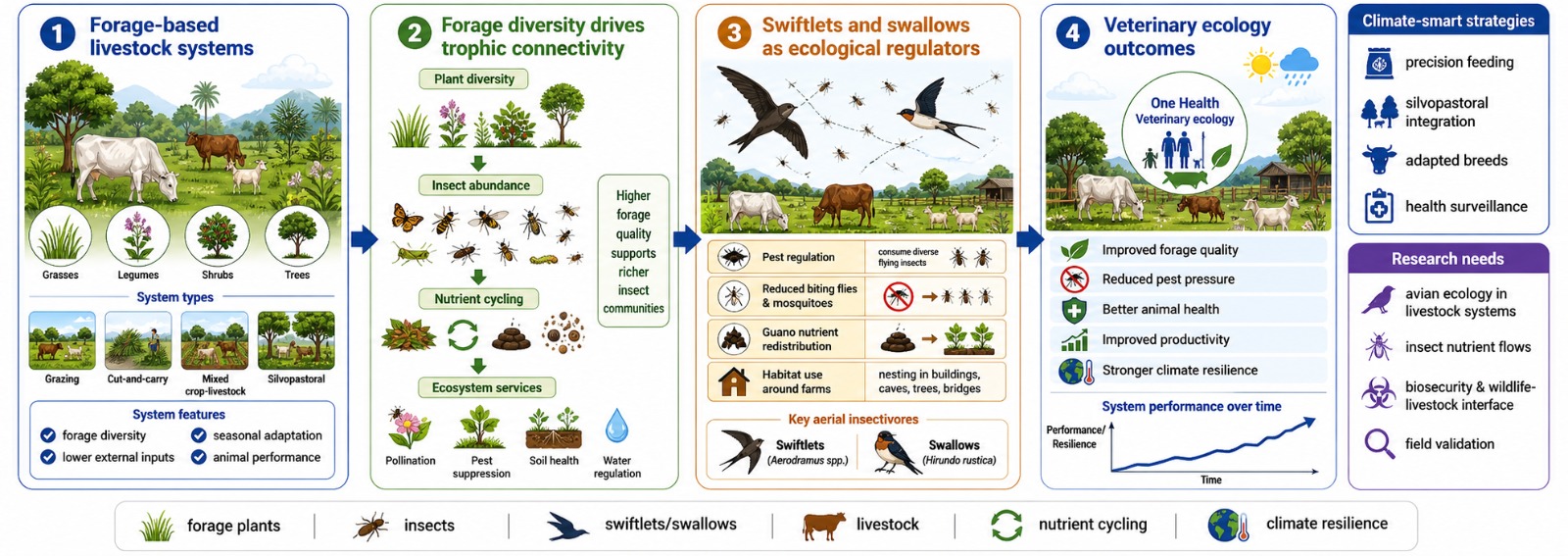
Veterinary sciences are increasingly central to the development of sustainable forage-based livestock systems, as they integrate animal health, nutrition, ecosystem functioning, and climate resilience within a One Health framework. This integrative review synthesizes current evidence on the evolving role of veterinary science in complex livestock agroecosystems, with particular emphasis on forage diversity, insect-mediated trophic processes, and the ecological functions of aerial insectivorous birds. The review highlights limitations of conventional livestock nutrition approaches that prioritize cost minimization and overlook ecological variability, seasonal dynamics, and non-livestock fauna. Forage-based systems, especially in tropical regions, benefit from diversified plant communities that enhance insect abundance, nutrient cycling, and ecosystem services, indirectly supporting livestock productivity and health. Swiftlets and swallows are examined as key ecological actors that regulate insect populations, contribute to nutrient redistribution, and interact closely with livestock-dominated landscapes. Climate change emerges as a major driver affecting forage quality, feed efficiency, and system stability, necessitating adaptive strategies such as precision feeding, climate-smart livestock systems, silvopastoral integration, and genetic adaptation. Despite growing interdisciplinary evidence, gaps remain in integrating avian ecology, insect-derived nutrient flows, and veterinary nutrition into coherent management frameworks. Addressing these gaps through interdisciplinary, data-driven, and translational research is essential to enhance the resilience, productivity, and sustainability of forage-based livestock agroecosystems.
References
Abdullah, D. A., Mamat, M. I. I., Abd Rahman, M., & Azmi, W. A. (2025). A Review on Aerodramus Spp. In Tropical Ecosystems: Emphasis on Food Sources for Edible Bird Nest (Ebn) Production. Journal of Sustainability Science and Management, 20(5), 1107–1119.
Afán, I., Arcos, J. M., Ramírez, F., García, D., Rodríguez, B., Delord, K., Boué, A., Micol, T., Weimerskirch, H., & Louzao, M. (2021). Where to head: environmental conditions shape foraging destinations in a critically endangered seabird. Marine Biology, 168(3), 23.
Anderson, B. D., Barnes, A. N., Umar, S., Guo, X., Thongthum, T., & Gray, G. C. (2023). Reverse zoonotic transmission (zooanthroponosis): an increasing threat to animal health. In Zoonoses: Infections Affecting Humans and Animals (pp. 25–87). Springer.
Appoo, J., Bunbury, N., Jaquemet, S., & Graham, N. A. J. (2024). Seabird nutrient subsidies enrich mangrove ecosystems and are exported to nearby coastal habitats. Iscience, 27(4).
Arazmi, F. N., Ismail, N. A., Daud, U. N. S., & Mansor, M. S. (2025a). DNA metabarcoding reveals distinct trophic niches among sympatric aerial insectivores (Family: Apodidae and Hirundinidae) in central Peninsular Malaysia. Nature Conservation, 59, 207–229.
Arazmi, F. N., Ismail, N. A., Daud, U. N. S., & Mansor, M. S. (2025b). DNA Metabarcoding Unveils Habitat-Linked Dietary Variation in Aerial Insectivorous Birds. Animals, 15(7), 974.
Arya, A. K., Bachheti, A., Bachheti, R. K., Kumar, A., Gupta, A. K., & Worku, L. A. (2025). Edible bird nest as a bioactive food ingredient for human health and market sustainability. Discover Food, 5(1), 404.
Ashworth, A. J., Avila, A., Smith, H., Winzeler, T. E., Owens, P., Flynn, C., O’Brien, P., Philipp, D., & Su, J. (2024). Predicting spatiotemporal patterns of productivity and grazing from multispectral data using neural network analysis based on system complexity. Agrosystems, Geosciences & Environment, 7(3), e20571.
Assan, N. (2026). Climate-smart approaches to livestock production for food security and sustainability. In Genetic and Reproductive Approaches for Sustainable Livestock Production (pp. 37–68). Elsevier.
Awobusuyi, T. D., Siwela, M., & Pillay, K. (2021). Nutritional composition of insect types most commonly consumed by the Olugboja Community of Ondo State, Nigeria. International Journal of Tropical Insect Science, 41(4), 2975–2982.
Bainard, L. D., Evans, B., Malis, E., Yang, T., & Bainard, J. D. (2020). Influence of annual plant diversity on forage productivity and nutrition, soil chemistry, and soil microbial communities. Frontiers in Sustainable Food Systems, 4, 560479.
Barbaro, L., Rusch, A., Muiruri, E. W., Gravellier, B., Thiery, D., & Castagneyrol, B. (2017). Avian pest control in vineyards is driven by interactions between bird functional diversity and landscape heterogeneity. Journal of Applied Ecology, 54(2), 500–508.
Barsotti, M. P., de Almeida, R. G., Macedo, M. C. M., Zawada, P., Werner, J., & Dickhoefer, U. (2024). Behavioural responses of beef cattle to different grazing systems and the influence of these responses on water productivity of livestock in a tropical savannah. Animal, 18(4), 101117.
Belicka, L. L., Burkholder, D., Fourqurean, J. W., Heithaus, M. R., Macko, S. A., & Jaffé, R. (2012). Stable isotope and fatty acid biomarkers of seagrass, epiphytic, and algal organic matter to consumers in a pristine seagrass ecosystem. Marine and Freshwater Research, 63(11), 1085–1097.
Bereczki, K., Hajdu, K., & Baldi, A. (2015). Effects of forest edge on pest control service provided by birds in fragmented temperate forests. Acta Zoologica Academiae Scientiarum Hungaricae, 61(3), 289–304.
Bereczki, K., Ódor, P., Csóka, G., Mag, Z., & Báldi, A. (2014). Effects of forest heterogeneity on the efficiency of caterpillar control service provided by birds in temperate oak forests. Forest Ecology and Management, 327, 96–105.
Besel, D., Hauber, M. E., Hunter, C., Ward-Smith, T., Raubenheimer, D., Millar, C. D., & Ismar, S. M. H. (2018). Multifactorial roles of interannual variability, season, and sex for foraging patterns in a sexually size monomorphic seabird, the Australasian gannet (Morus serrator). Marine Biology, 165(4), 72.
Biswas, B. K., & Das, S. K. (2026). Livestock and global change: Emerging issues for sustainable food production. In Genetic and Reproductive Approaches for Sustainable Livestock Production (pp. 15–36). Elsevier.
Boonsaen, P., Nevot, A., Onju, S., Fossaert, C., Chalermwong, P., Thaisungnoen, K., Lucas, A., Thévenon, S., Masmeatathip, R., & Jittapalapong, S. (2024). Measurement of the direct impact of hematophagous flies on feeder cattle: an unexpectedly high potential economic impact. Insects, 15(10), 735.
Bosi, C., Sentelhas, P. C., Huth, N. I., Pezzopane, J. R. M., Andreucci, M. P., & Santos, P. M. (2020). APSIM-Tropical Pasture: A model for simulating perennial tropical grass growth and its parameterisation for palisade grass (Brachiaria brizantha). Agricultural Systems, 184, 102917.
Botha, J. A., Rishworth, G. M., Thiebault, A., Green, D. B., & Pistorius, P. A. (2017). Sex-specific foraging over space and time in Cape gannets during chick rearing. Marine Ecology Progress Series, 579, 157–167.
Butt, A. A., & Ahmed, Z. (2025). Advanced Veterinary Sciences for Sustainable Agriculture and Global Food Security. One Health Integration: Global Perspectives on Animal Health and Sustainable Agriculture, 135–164.
Cach-Pérez, M. J., Villanueva López, G., Alayón Gamboa, J. A., Nahed Toral, J., & Casanova Lugo, F. (2021). Microclimate management: From traditional agriculture to livestock systems in tropical environments. In Environment and Climate-smart Food Production (pp. 1–29). Springer.
Carneiro, L. de S., Mendes, L. C., Rodrigues, D., Porfírio-da-Silva, V., & Pontes, L. da S. (2025). Impact of tree integration in crop–livestock systems with varying nitrogen rates. Animal Production Science, 65(7), AN24340.
Cassano, C. R., Silva, R. M., Mariano-Neto, E., Schroth, G., & Faria, D. (2016). Bat and bird exclusion but not shade cover influence arthropod abundance and cocoa leaf consumption in agroforestry landscape in northeast Brazil. Agriculture, Ecosystems & Environment, 232, 247–253.
Cebrian, J., Shurin, J. B., Borer, E. T., Cardinale, B. J., Ngai, J. T., Smith, M. D., & Fagan, W. F. (2009). Producer nutritional quality controls ecosystem trophic structure. PloS One, 4(3), e4929.
Chan, K. S., Tan, J., & Goh, W. L. (2019). Diet profiling of house-farm swiftlets (Aves, Apodidae, Aerodramus sp.) in three landscapes in Perak, Malaysia, using high-throughput sequencing. Tropical Ecology, 60(3), 379–388.
Chand, S., Indu, Singhal, R. K., & Govindasamy, P. (2022). Agronomical and breeding approaches to improve the nutritional status of forage crops for better livestock productivity. Grass and Forage Science, 77(1), 11–32.
Chaudhry, A. S. (2008). Forage based animal production systems and sustainability, an invited keynote. Revista Brasileira de Zootecnia, 37, 78–84.
Chisoro, P., Mazizi, B., Jaja, I. F., Assan, N., & Nkukwana, T. (2025). Sustainable utilization of wild fruits and respective tree byproducts as partial feed ingredients or supplements in livestock rations. Frontiers in Animal Science, 6, 1501412.
Cimiotti, D. S., Hötker, H., & Garthe, S. (2024). Exploratory and seasonal movements of adult common shelducks in the eastern Wadden Sea. Journal of Ornithology, 165(2), 289–300.
Corcket, E., Giffard, B., & Sforza, R. F. H. (2017). Food webs and multiple biotic interactions in plant–herbivore models. In Advances in botanical research (Vol. 81, pp. 111–137). Elsevier.
De Lima, R. F., Bird, J. P., & Barlow, J. (2011). Research effort allocation and the conservation of restricted-range island bird species. Biological Conservation, 144(1), 627–632.
Delaby, L., Buckley, F., McHugh, N., & Blanc, F. (2021). Characteristics of robust animals for grass-based production systems. Irish Journal of Agricultural and Food Research, 59(2), 246–257.
Denisow, B., & Wrzesień, M. B. (2015). The importance of field-margin location for maintenance of food niches for pollinators. Journal of Apicultural Science, 59(1).
Dieguez Cameroni, F. J., Varela Casadey, F., Boscana, M., Schinatto, F., & Bussoni, A. (2024). Advancing carbon neutrality in Silvopastoral systems: a case study applying agent-based modeling. Agroforestry Systems, 98(7), 2209–2224.
Distel, R. A., Arroquy, J. I., Lagrange, S., & Villalba, J. J. (2020). Designing diverse agricultural pastures for improving ruminant production systems. Frontiers in Sustainable Food Systems, 4, 596869.
Douglas, A. E. (2014). Molecular dissection of nutrient exchange at the insect-microbial interface. Current Opinion in Insect Science, 4, 23–28.
Duckwitz, V., Vogt, L., Hautzinger, C., Bartel, A., Haase, S., Wiegard, M., & Doherr, M. G. (2021). Students’ acceptance of case‐based blended learning in mandatory interdisciplinary lectures for clinical medicine and veterinary public health. Veterinary Record Open, 8(1), e14.
Espitia Buitrago, P. A., Hernández, L. M., Burkart, S., Palmer, N., & Cardoso Arango, J. A. (2021). Forage-fed insects as food and feed source: opportunities and constraints of edible insects in the tropics. Frontiers in Sustainable Food Systems, 5, 724628.
Everwand, G., Rösch, V., Tscharntke, T., & Scherber, C. (2014). Disentangling direct and indirect effects of experimental grassland management and plant functional-group manipulation on plant and leafhopper diversity. BMC Ecology, 14(1), 1.
Fan, Q., Liu, X., Wang, Y., Xu, D., & Guo, B. (2022). Recent advances in edible bird’s nests and edible bird’s nest hydrolysates. Food Science and Technology, 42, e67422.
Fujita, M., & Leh, C. (2019). The feeding ecology of edible-nest swiftlets in a modified landscape in Sarawak. In Anthropogenic Tropical Forests: Human–Nature Interfaces on the Plantation Frontier (pp. 401–415). Springer.
Fusaro, S., Squartini, A., & Paoletti, M. G. (2018). Functional biodiversity, environmental sustainability and crop nutritional properties: A case study of horticultural crops in north-eastern Italy. Applied Soil Ecology, 123, 699–708.
Fynn, R. W. S., Kirkman, K. P., & Dames, R. (2017). Optimal grazing management strategies: evaluating key concepts. African Journal of Range & Forage Science, 34(2), 87–98.
Gazzarin, C., Haas, T., Hofstetter, P., & Höltschi, M. (2018). Milk production: fresh grass with low concentrates pays off.
Geary, B., Leberg, P. L., Purcell, K. M., Walter, S. T., & Karubian, J. (2020). Breeding brown pelicans improve foraging performance as energetic needs rise. Scientific Reports, 10(1), 1686.
Grassauer, F., Ferdous, J., & Pelletier, N. (2023). Manure valorization using black soldier fly larvae: a review of current systems, production characteristics, utilized feed substrates, and bioconversion and nitrogen conversion efficiencies. Sustainability, 15(16), 12177.
Groll, T., Aupperle-Lellbach, H., Mogler, C., & Steiger, K. (2024). Comparative pathology in oncology-Best practice. Pathologie (Heidelberg, Germany).
Grüebler, M. U., Korner‐Nievergelt, F., & Von Hirschheydt, J. (2010). The reproductive benefits of livestock farming in barn swallows Hirundo rustica: quality of nest site or foraging habitat? Journal of Applied Ecology, 47(6), 1340–1347.
Guerra, A. S., Bui, A., Klope, M., Orr, D. A., Shaffer, S. A., & Young, H. S. (2022). Leaving more than footprints: Anthropogenic nutrient subsidies to a protected area. Ecosphere, 13(12), e4371.
Hacker, R. B., Sinclair, K., & Waters, C. M. (2020). Total grazing pressure–a defining concept for extensive pastoral systems in the southern rangelands of Australia. In The Rangeland Journal (Vol. 41, Issue 6, pp. 457–460). CSIRO Publishing.
Hasegawa, M., & Arai, E. (2018). Convergent evolution of the tradeoff between egg size and tail fork depth in swallows and swifts. Journal of Avian Biology, 49(8), e01684.
Hayes, B. H., Vergne, T., Andraud, M., & Rose, N. (2023). Mathematical modeling at the livestock-wildlife interface: scoping review of drivers of disease transmission between species. Frontiers in Veterinary Science, 10, 1225446.
Henderson, I., Holt, C., & Vickery, J. (2007). National and regional patterns of habitat association with foraging Barn Swallows Hirundo rustica in the UK. Bird Study, 54(3), 371–377.
Herrera, H., & Kopainsky, B. (2023). Using microworlds for policymaking in the context of resilient farming systems. Journal of Simulation, 17(5), 607–631.
Heyman, E., & Gunnarsson, B. (2011). Management effect on bird and arthropod interaction in suburban woodlands. BMC Ecology, 11(1), 8.
Hoveland, C. S., & Monson, W. G. (1980). Genetic and environmental effects on forage quality. Crop Quality, Storage, and Utilization, 139–168.
Irick, D. L., Gu, B., Li, Y. C., Inglett, P. W., Frederick, P. C., Ross, M. S., Wright, A. L., & Ewe, S. M. L. (2015). Wading bird guano enrichment of soil nutrients in tree islands of the Florida Everglades. Science of the Total Environment, 532, 40–47.
János, G., Nikolett, K., Viktória, S.-K., Endre, S., Márton, H., Árisz, Z., Miklós, M., Tamás, T., Péter, K., & Luca, Z. (2025). Füsti fecskék (Hirundo rustica) betörő hidegfront okozta tömeges elhullása 2024 szeptemberében Magyarországon. Magyar Állatorvosok Lapja, 147(8).
Jiménez-Albarral, J. J., Morán-López, T., Illera, J. C., Miñarro, M., & García, D. (2025). Insectivore diet and abundance determine the contribution of bird species to services and disservices in an agricultural ecosystem. Ornithological Applications, 127(2), duaf006.
Karmacharya, D., Herrero-García, G., Luitel, B., Rajbhandari, R., & Balseiro, A. (2024). Shared infections at the wildlife–livestock interface and their impact on public health, economy, and biodiversity. Animal Frontiers, 14(1), 20–29.
Khalil, F., Yapati, H., Al Blallam, Z., & Jose, R. (2022). Seasonal effects on growth, physiology, hematology and biochemical profiles of Naeemi sheep breed. Advances in Animal and Veterinary Sciences, 10, 2161–2170.
Kieckbusch, D. K., Koch, M. S., Serafy, J. E., & Anderson, W. T. (2004). Trophic linkages among primary producers and consumers in fringing mangroves of subtropical lagoons. Bulletin of Marine Science, 74(2), 271–285.
Kinyuru, J. N., Mogendi, J. B., Riwa, C. A., & Ndung’u, N. W. (2015). Edible insects—A novel source of essential nutrients for human diet: Learning from traditional knowledge. Animal Frontiers, 5(2), 14–19.
Kock, R. A. (2004). The Wildlife Domestic Animal Disease Interface—should Africa adopt a hard or soft edge? Transactions of the Royal Society of South Africa, 59(1), 10–14.
Kross, S. M., Kelsey, T. R., McColl, C. J., & Townsend, J. M. (2016). Field-scale habitat complexity enhances avian conservation and avian-mediated pest-control services in an intensive agricultural crop. Agriculture, Ecosystems & Environment, 225, 140–149.
Kumar, N., Kumar, A., Mittal, D., & Kumar, M. (2025). One Health Concept and Initiatives in Veterinary Public Health. Epidemiology and Environmental Hygiene in Veterinary Public Health, 299–308.
Kumari, P., Shee, S., & Mahesh, M. S. (2025). Nutritional Approaches to Augment Production and Profitability in Livestock Enterprises. In Sustainable Agriculture Management in Semi-Arid Climates: Volume 2 (pp. 243–256). Springer.
Lamy, E., Van Harten, S., Sales-Baptista, E., Guerra, M. M. M., & De Almeida, A. M. (2012). Factors influencing livestock productivity. In Environmental stress and amelioration in livestock production (pp. 19–51). Springer.
Laws, A. N., Prather, C. M., Branson, D. H., & Pennings, S. C. (2018). Effects of grasshoppers on prairies: Herbivore composition matters more than richness in three grassland ecosystems. Journal of Animal Ecology, 87(6), 1727–1737.
Luhr, D., & Groschel, M. (2006). The occurence of the Barn Swallow Hirundo rustica in northern Bielefeld and it’s dependence on different environmental factors. VOGELWARTE, 44(4), 229.
Mansor, M. S., Halim, M. R. A., Abdullah, N. A., & Ramli, R. (2020). Barn Swallows Hirundo rustica in Peninsular Malaysia: urban winter roost counts after 50 years, and dietary segregation from house-farmed swiftlets Aerodramus sp. Raffles Bulletin of Zoology, 68.
Manyike, J. Z., Taruvinga, A., & Akinyemi, B. E. (2025). Mapping the research landscape of livestock adaptation to climate change: a bibliometric review using Scopus database (1994–2023). Frontiers in Climate, 7, 1567674.
Marchão, R. L., Mendes, I. C., Vilela, L., Júnior, R. G., Niva, C. C., Pulrolnik, K., Souza, K. W., & de Carvalho, A. M. (2024). Integrated crop–livestock–forestry systems for improved soil health, environmental benefits, and sustainable production. Soil Health Series: Volume 3 Soil Health and Sustainable Agriculture in Brazil, 19–61.
McFadden, T. N., Kauffman, J. B., & Bhomia, R. K. (2016). Effects of nesting waterbirds on nutrient levels in mangroves, Gulf of Fonseca, Honduras. Wetlands Ecology and Management, 24(2), 217–229.
Militão, T., Kürten, N., & Bouwhuis, S. (2023). Sex-specific foraging behaviour in a long-lived seabird. Marine Biology, 170(11), 132.
Miller, R. S., Farnsworth, M. L., & Malmberg, J. L. (2013). Diseases at the livestock–wildlife interface: status, challenges, and opportunities in the United States. Preventive Veterinary Medicine, 110(2), 119–132.
Møller, A. P., de Lope, F., & Saino, N. (2005). Reproduction and migration in relation to senescence in the barn swallow Hirundo rustica: a study of avian ‘centenarians.’ Age, 27(4), 307–318.
Monteiro, L. P., Silva Junior, N. R., Vital, C. E., Barros, R. A., Barros, E., Auad, A. M., Pereira, J. F., Ramos, H. J. de O., & Oliveira, M. G. de A. (2021). Protein and phytohormone profiles of Mahanarva spectabilis salivary glands infesting different forages. Archives of Insect Biochemistry and Physiology, 106(3), e21773.
New, T. R. (2007). Are predatory arthropods useful indicators in Australian agroecosystems? Australian Journal of Experimental Agriculture, 47(4), 450–454.
Nitschke, N., Wiesner, K., Hilke, I., Eisenhauer, N., Oelmann, Y., & Weisser, W. W. (2015). Increase of fast nutrient cycling in grassland microcosms through insect herbivory depends on plant functional composition and species diversity. Oikos, 124(2), 161–173.
Nooker, J. K., Dunn, P. O., & Whittingham, L. A. (2005). Effects of food abundance, weather, and female condition on reproduction in tree swallows (Tachycineta bicolor). The Auk, 122(4), 1225–1238.
Oddon, S. B., Rossi, G., Bongiorno, V., Gasco, L., Ojha, S., Rastello, L., Renna, M., Ribeiro, L. R., Sandrock, C., & Schlüter, O. K. (2025). Advancing insect utilization for food and feed: standardizing processing methods, enhancing techno-functional properties, and refining feeding trial protocols. Journal of Insects as Food and Feed, 1(aop), 1–30.
Ojha, S., Bekhit, A. E.-D., Grune, T., & Schlüter, O. K. (2021). Bioavailability of nutrients from edible insects. Current Opinion in Food Science, 41, 240–248.
Oluwakemi Bawala, T., & Olaleye Akinsoyinu, A. (2006). Nutritional evaluation of rumen epithelial tissue scrapings in goat nutrition. Nutrition & Food Science, 36(6), 414–418.
Orłowski, G., & Karg, J. (2013). Diet breadth and overlap in three sympatric aerial insectivorous birds at the same location. Bird Study, 60(4), 475–483.
Ortega-Jimenez, E., Alexandre, G., Coppry, O., Saminadin, G., Cruz, P., & Xandé, A. (2006). Post-grazing residue control, season and forage characteristics of tropical pastures grazed by goats and ewes in Guadeloupe (FWI). JOURNAL OF AGRICULTURE-UNIVERSITY OF PUERTO RICO, 90(1/2), 37.
Oudman, T., Piersma, T., Ahmedou Salem, M. V, Feis, M. E., Dekinga, A., Holthuijsen, S., Ten Horn, J., van Gils, J. A., & Bijleveld, A. I. (2018). Resource landscapes explain contrasting patterns of aggregation and site fidelity by red knots at two wintering sites. Movement Ecology, 6(1), 24.
Pathak, R. K., & Kim, J.-M. (2022). Vetinformatics from functional genomics to drug discovery: insights into decoding complex molecular mechanisms of livestock systems in veterinary science. Frontiers in Veterinary Science, 9, 1008728.
Pathak, R. K., & Kim, J.-M. (2024). Veterinary systems biology for bridging the phenotype–genotype gap via computational modeling for disease epidemiology and animal welfare. Briefings in Bioinformatics, 25(2).
Pathak, R. K., & Kim, J.-M. (2025). Introduction to Vetinformatics and Its Application in Veterinary Science. In Bioinformatics in Veterinary Science: Vetinformatics (pp. 1–22). Springer.
Pereira, F. A. C., Schaefer, C. E. G. R., Ribeiro Filho, A. C., Senra, E. O., Francelino, M. R., Firmino, F. H. T., Gjorup, D. F., Siqueira, R. G., da Silva, T. P., & Pereira, M. G. (2025). Ornithogenesis and phosphate forms in soils influenced by penguins from the subantarctic Falkland Islands. Catena, 261, 109501.
Pezzopane, J. R. M., Bernardi, A. C. de C., Azenha, M. V., Oliveira, P. P. A., Bosi, C., Pedroso, A. de F., & Esteves, S. N. (2020). Production and nutritive value of pastures in integrated livestock production systems: shading and management effects. Scientia Agricola, 77, e20180150.
Pinotti, L., & Ottoboni, M. (2021). Substrate as insect feed for bio-mass production. Journal of Insects as Food and Feed, 7(5), 585–596.
Poli, C. L., Harrison, A.-L., Vallarino, A., Gerard, P. D., & Jodice, P. G. R. (2017). Dynamic oceanography determines fine scale foraging behavior of Masked Boobies in the Gulf of Mexico. PloS One, 12(6), e0178318.
Pomar, C., & Remus, A. (2023). Fundamentals, limitations and pitfalls on the development and application of precision nutrition techniques for precision livestock farming. Animal, 17, 100763.
Priya, & Kumar, R. (2023). Insects Nutrition and 3D Printing. In 3D Printing of Sustainable Insect Materials (pp. 69–81). Springer.
Puckett, H. L., Brandle, J. R., Johnson, R. J., & Blankenship, E. E. (2009). Avian foraging patterns in crop field edges adjacent to woody habitat. Agriculture, Ecosystems & Environment, 131(1–2), 9–15.
Ramana, D. B. V. (2022). Livestock based production systems for climate adaptation in dryland areas. In Climate change adaptations in dryland agriculture in semi-arid areas (pp. 127–141). Springer.
Rauw, W. M., Baumgard, L. H., & Dekkers, J. C. M. (2025). Feed efficiency and metabolic flexibility in livestock. Animal, 19(1), 101376.
Rosas‐Ramos, N., Baños‐Picón, L., Tormos, J., & Asís, J. D. (2019). The complementarity between ecological infrastructure types benefits natural enemies and pollinators in a Mediterranean vineyard agroecosystem. Annals of Applied Biology, 175(2), 193–201.
Russell, C. L. (2005). An overview of the integrative research review. Progress in Transplantation, 15(1), 8–13.
Sarto, M. V. M., Borges, W. L. B., Sarto, J. R. W., Rice, C. W., & Rosolem, C. A. (2020). Root and shoot interactions in a tropical integrated crop–livestock–forest system. Agricultural Systems, 181, 102796.
Saunders, S. P., Wu, J. X., Gow, E. A., Adams, E., Bateman, B. L., Bayard, T., Beilke, S., Dayer, A. A., Fournier, A. M. V, & Fox, K. (2021). Bridging the research-implementation gap in avian conservation with translational ecology. The Condor, 123(3), duab018.
Selter, F., Persson, K., Kunzmann, P., & Neitzke, G. (2023). End-of-life decisions: A focus group study with German health professionals from human and veterinary medicine. Frontiers in Veterinary Science, 10, 1044561.
Severino da Silva, L. (2025). Enhancing Climate Resilience of Forage Ecosystems Through Sustainable Intensification and Educational Knowledge Transfer in the Southeastern USA. Crops, 5(4), 42.
Shaikh, K., Dange, D., Magar, Z. A. A., & Gaikwad, P. S. (2025). Global Overview of Veterinary Sciences. One Health Integration: Global Perspectives on Animal Health and Sustainable Agriculture, 1–32.
Siembieda, J. L., Kock, R. A., McCracken, T. A., & Newman, S. H. (2011). The role of wildlife in transboundary animal diseases. Animal Health Research Reviews, 12(1), 95–111.
Sierra, J., Stark, F., & Fanchone, A. (2025). Modeling the effect of land use and manure management on soil carbon sequestration in tropical mixed crop-livestock systems: A case study in Guadeloupe (Caribbean). Geoderma Regional, e00968.
Simpson, L. T., Canty, S. W. J., Cissell, J. R., Steinberg, M. K., Cherry, J. A., & Feller, I. C. (2021). Bird rookery nutrient over-enrichment as a potential accelerant of mangrove cay decline in Belize. Oecologia, 197(3), 771–784.
Simpson, R. M., Hoover, S. B., Davis, B. J., Hickerson, J., Miller, M. A., Kiupel, M., Cullen, J. M., Dwyer, J. E., Wei, B.-R., & Rosol, T. J. (2020). Inter-Institutional Partnerships to Develop Veterinarian–Investigators through the NIH Comparative Biomedical Scientist Training Program Benefit One Health Goals. Journal of Veterinary Medical Education, 47(5), 619–631.
Smith, G. C., Brough, T., Podgórski, T., Ježek, M., Šatrán, P., Vaclavek, P., & Delahay, R. (2022). Defining and testing a wildlife intervention framework for exotic disease control. Ecological Solutions and Evidence, 3(4), e12192.
Smyshlyaeva, O. I., Severova, E. E., Krylovich, O. A., Kuzmicheva, E. A., Savinetsky, A. B., Dixie, W., & Hatfield, V. (2021). Ornithogenic vegetation: How significant has the seabird influence been on the Aleutian Island vegetation during the Holocene? Ecology and Evolution, 11(20), 14088–14100.
Soares, C. B., Hoga, L. A. K., Peduzzi, M., Sangaleti, C., Yonekura, T., & Silva, D. R. A. D. (2014). Integrative review: concepts and methods used in nursing. Revista Da Escola de Enfermagem Da USP, 48, 335–345.
Sokame, B. M., Runyu, J. C., & Tonnang, H. E. Z. (2024). Integrating edible insect into circular agriculture for sustainable production. Sustainable Production and Consumption, 52, 80–94.
Sujatha, T., Kannan, A., Jeyakumar, S., Kundu, A., Velmurugan, A., Sunder, J., Swarnam, T. P., & De, A. K. (2008). Livestock and People–The Intimate Relation Under Threat. In Biodiversity and Climate Change Adaptation in Tropical Islands (pp. 433–457). Elsevier.
Tamboli, P., Chaurasiya, A. K., Upadhyay, D., & Kumar, A. (2023). Climate change impact on forage characteristics: an appraisal for livestock production. In Molecular interventions for developing climate-smart crops: a forage perspective (pp. 183–196). Springer.
Usigbe, M. J., Uyeh, D. D., Park, T., Ha, Y., & Mallipeddi, R. (2025). Many objective optimization and decision support for dairy cattle feed formulation. Scientific Reports, 15(1), 13451.
van der Lee, G. H., Vonk, J. A., Verdonschot, R. C. M., Kraak, M. H. S., Verdonschot, P. F. M., & Huisman, J. (2021). Eutrophication induces shifts in the trophic position of invertebrates in aquatic food webs. Ecology, 102(3), e03275.
Wan, N.-F., Zheng, X.-R., Fu, L.-W., Kiær, L. P., Zhang, Z., Chaplin-Kramer, R., Dainese, M., Tan, J., Qiu, S.-Y., & Hu, Y.-Q. (2020). Global synthesis of effects of plant species diversity on trophic groups and interactions. Nature Plants, 6(5), 503–510.
Wang, B., Zhang, Y., Li, J., Wu, M., Shi, Y., Sun, X., Xiao, X., Zhang, P., Shi, Y., & Li, Y. (2025). Revealing dietary habits and intestinal microbiome composition of the Beijing swift (Apus apus pekinensis) through regurgitated pellets and fecal samples. Frontiers in Microbiology, 16, 1693396.
Washburn, S. P., & Mullen, K. A. E. (2014). Invited review: Genetic considerations for various pasture-based dairy systems. Journal of Dairy Science, 97(10), 5923–5938.
Wedin, D. A., & Russelle, M. P. (2020). Nutrient cycling in forage production systems. Forages: The Science of Grassland Agriculture, 2, 215–225.
Wróbel, B., Zielewicz, W., & Paszkiewicz-Jasińska, A. (2025). Improving forage quality from permanent grasslands to enhance ruminant productivity. Agriculture, 15(13), 1438.
Xiao, H., Hu, Y., Lang, Z., Fang, B., Guo, W., Zhang, Q. I., Pan, X., & Lu, X. (2017). How much do we know about the breeding biology of bird species in the world? Journal of Avian Biology, 48(4), 513–518.
Xiong, L.-H., Wu, X., & Lu, J.-J. (2010). Bird predation on concealed insects in a reed-dominated estuarine tidal marsh. Wetlands, 30(6), 1203–1211.
Yang, L., & Chen, C. (2021). Research progress on driving factors of species diversity of grassland insects. IOP Conference Series: Earth and Environmental Science, 692(3), 32094.
Zhang, S., Lai, C., Zhao, J., & Wang, J. (2025). Big Data and AI‐Powered Modeling: A Pathway to Sustainable Precision Animal Nutrition. Advanced Science, 12(41), e07564.
Zhou, Y., Wang, D., Zhou, S., Duan, H., Guo, J., & Yan, W. (2022). Nutritional composition, health benefits, and application value of edible insects: A review. Foods, 11(24), 3961.
ZHU, H., PENG, Y., & WANG, D. (2008). Effects of plant on insect diversity: A review. Chinese Journal of Ecology, 27(12), 2215.
Zwolicki, A., Zmudczyńska-Skarbek, K. M., Iliszko, L., & Stempniewicz, L. (2013). Guano deposition and nutrient enrichment in the vicinity of planktivorous and piscivorous seabird colonies in Spitsbergen. Polar Biology, 36(3), 363–372.
Additional Files
Published
How to Cite
Issue
Section
License
Copyright (c) 2026 Environmental and Agriculture Management

This work is licensed under a Creative Commons Attribution-NonCommercial-ShareAlike 4.0 International License.
Authors retain copyright and grant the journal right of first publication with the work simultaneously licensed under a Creative Commons Attribution License that allows others to share the work with an acknowledgement of the work's authorship and initial publication in this journal.
Authors are able to enter into separate, additional contractual arrangements for the non-exclusive distribution of the journal's published version of the work (e.g., post it to an institutional repository or publish it in a book), with an acknowledgement of its initial publication in this journal.
Authors are permitted and encouraged to post their work online (e.g., in institutional repositories or on their website) prior to and during the submission process, as it can lead to productive exchanges, as well as earlier and greater citation of published work