Microplastic contamination in traditional herbal beverages: sources, transfer pathways, and mitigation across the field-to-consumption continuum
DOI:
https://doi.org/10.31102/eam.3.2.135-156Keywords:
emerging contaminants, herbal beverages, medicinal plants, microplasticsAbstract
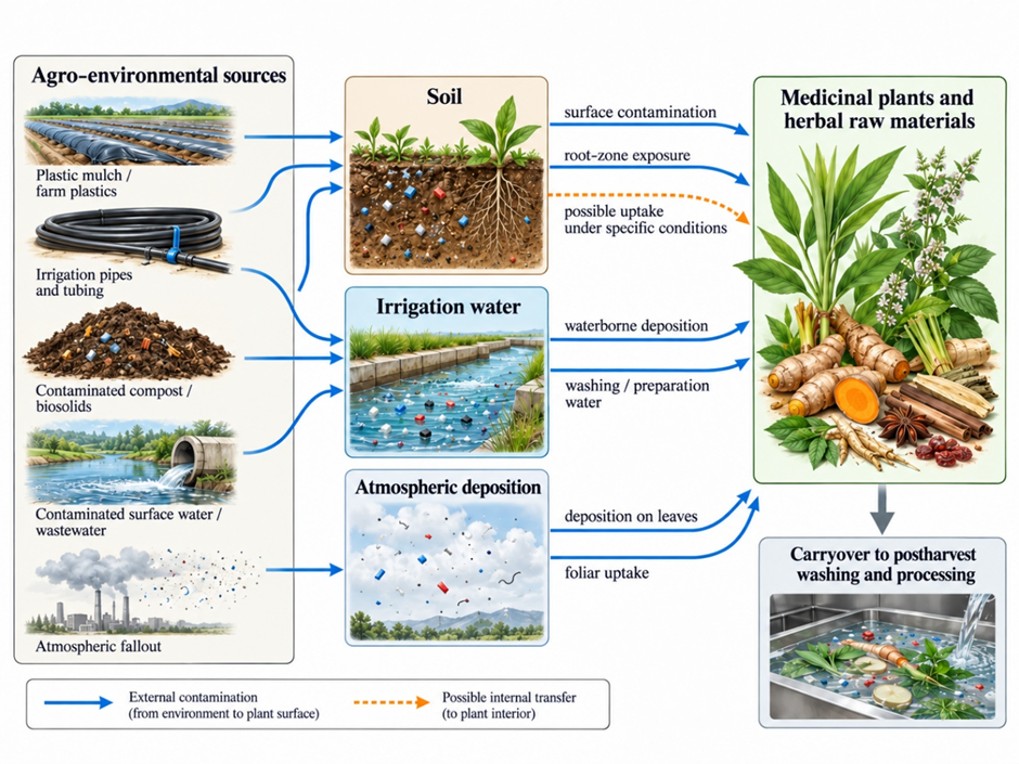
Traditional herbal beverages, including jamu, wedang pokak, herbal infusions, and liquid herbal medicines, may be exposed to microplastic contamination throughout production and consumption. This structured critical review synthesizes peer-reviewed Scopus-indexed studies published mainly from 2019 to August 2026 to identify contamination sources, transfer pathways, and mitigation strategies across the field-toconsumption continuum. Direct evidence from herbal teas and liquid herbal medicines was distinguished from transferable findings involving agricultural systems, tea processing, spices, commercial beverages, and food contact materials. Evidence identifies agricultural soils, irrigation water, atmospheric deposition, plant surfaces, potential plant uptake, processing equipment, filtration, hot extraction, and packaging as contamination sources or pathways. Tea-based analogue studies suggest that manufacturing may contribute more substantially to microplastic abundance than cultivation or brewing, while heating plastic-packaged liquid herbal medicines can markedly increase particle release. However, differences in particle-size thresholds, sample preparation, contamination controls, and polymer identification limit cross-study comparisons and quantitative exposure assessment. Consequently, existing exposure estimates should be interpreted as preliminary screening indicators rather than definitive health-risk thresholds. This review proposes a field-toconsumption management framework integrating cleaner raw materials and water, reduced high-temperature plastic contact, low-shedding processing equipment, validated packaging, and microplastic-specific quality assurance. Future studies should employ standardized analytical protocols and paired sampling across traditional herbal beverage production chains, particularly in tropical regions, to identify critical contamination stages, quantify transfer, and validate mitigation effectiveness
References
Azeem, I., Adeel, M., Ahmad, M. A., Shakoor, N., Jiangcuo, G. D., Azeem, K., Ishfaq, M., Shakoor, A., Ayaz, M., Xu, M., & Rui, Y. 2021. Uptake and Accumulation of Nano/Microplastics in Plants: A Critical Review. Nanomaterials, 11 (11), 2935. https://doi.org/10.3390/nano11112935
Canga, E. M., Gowen, A., & Xu, J.-L. 2024. Assessing the inconsistency of microplastic measurements in foods and beverages. Comprehensive Reviews in Food Science and Food Safety, 23 (2), e13315. https://doi.org/10.1111/1541-4337.13315
Estiasih, T., Maligan, J. M., Witoyo, J. E., Mu’alim, A. A. H., Ahmadi, K., Mahatmanto, T., & Zubaidah, E. 2025. Indonesian traditional herbal drinks: diversity, processing, and health benefits. Journal of Ethnic Foods, 12 (1), 7. https://doi.org/10.1186/s42779-025-00267-5
Fard, N. J. H., Jahedi, F., & Turner, A. 2025. Microplastics and nanoplastics in tea: Sources, characteristics and potential impacts. Food Chemistry, 466 142111. https://doi.org/10.1016/j.foodchem.2024.142111
Gökkaya, A., & Güzel İzmi̇rli̇, Ş. 2025. Microplastic contamination in some herbal teas and human risk assessment: Türkiye. Food and Chemical Toxicology, 205 115718. https://doi.org/10.1016/j.fct.2025.115718
Hernandez, L. M., Xu, E. G., Larsson, H. C. E., Tahara, R., Maisuria, V. B., & Tufenkji, N. 2019. Plastic Teabags Release Billions of Microparticles and Nanoparticles into Tea. Environmental Science & Technology, 53 (21), 12300-12310. https://doi.org/10.1021/acs.est.9b02540
Hussain, K. A., Romanova, S., Okur, I., Zhang, D., Kuebler, J., Huang, X., Wang, B., Fernandez-Ballester, L., Lu, Y., Schubert, M., & Li, Y. 2023. Assessing the Release of Microplastics and Nanoplastics from Plastic Containers and Reusable Food Pouches: Implications for Human Health. Environmental Science & Technology, 57 (26), 9782-9792. https://doi.org/10.1021/acs.est.3c01942
Jadhav, E. B., Sankhla, M. S., Bhat, R. A., & Bhagat, D. S. 2021. Microplastics from food packaging: An overview of human consumption, health threats, and alternative solutions. Environmental Nanotechnology, Monitoring & Management, 16 100608. https://doi.org/10.1016/j.enmm.2021.100608
Jahedi, F., Turner, A., & Jaafarzadeh Haghighi Fard, N. 2026. Spices under the microscope: First detection and characterization of microplastics in turmeric, black pepper, and chili. Case Studies in Chemical and Environmental Engineering, 13 101334. https://doi.org/10.1016/j.cscee.2026.101334
Jin, T., Tang, J., Lyu, H., Wang, L., Gillmore, A. B., & Schaeffer, S. M. 2022. Activities of Microplastics (MPs) in Agricultural Soil: A Review of MPs Pollution from the Perspective of Agricultural Ecosystems. Journal of Agricultural and Food Chemistry, 70 (14), 4182-4201. https://doi.org/10.1021/acs.jafc.1c07849
Joshi, R., Adhikari, S., Kim, Y., Lee, D., & Cho, B.-K. 2025. A qualitative method for detecting microplastics in liquid herbal medicine using gold nanoparticle SERS substrates. Journal of Environmental Chemical Engineering, 13 (2), 116006. https://doi.org/10.1016/j.jece.2025.116006
Kadac-Czapska, K., Trzebiatowska, P. J., Knez, E., Zaleska-Medynska, A., & Grembecka, M. 2023. Microplastics in food - a critical approach to definition, sample preparation, and characterisation. Food Chemistry, 418 135985. https://doi.org/10.1016/j.foodchem.2023.135985
Khan, A., Jie, Z., Wang, J., Nepal, J., Ullah, N., Zhao, Z.-Y., Wang, P.-Y., Ahmad, W., Khan, A., Wang, W., Li, M.-Y., Zhang, W., Elsheikh, M. S., & Xiong, Y.-C. 2023. Ecological risks of microplastics contamination with green solutions and future perspectives. Science of The Total Environment, 899 165688. https://doi.org/10.1016/j.scitotenv.2023.165688
Li, J., Wang, Q., Cui, M., Yu, S., Chen, X., & Wang, J. 2023. Release characteristics and toxicity assessment of micro/nanoplastics from food-grade nonwoven bags. Science of The Total Environment, 883 163642. https://doi.org/10.1016/j.scitotenv.2023.163642
Li, Y., Zhang, J., Xu, L., Li, R., Zhang, R., Li, M., Ran, C., Rao, Z., Wei, X., Chen, M., Wang, L., Li, Z., Xue, Y., Peng, C., Liu, C., Sun, H., Xing, B., & Wang, L. 2025. Leaf absorption contributes to accumulation of microplastics in plants. Nature, 641 (8063), 666-673. https://doi.org/10.1038/s41586-025-08831-4
Lwanga, E. H., Beriot, N., Corradini, F., Silva, V., Yang, X., Baartman, J., Rezaei, M., van Schaik, L., Riksen, M., & Geissen, V. 2022. Review of microplastic sources, transport pathways and correlations with other soil stressors: a journey from agricultural sites into the environment. Chemical and Biological Technologies in Agriculture, 9 (1), 20. https://doi.org/10.1186/s40538-021-00278-9
Mondal, R., Sarkar, D. J., Bhattacharyya, S., Chaudhuri, P., & Das, B. K. 2025. Tracing source of microplastics contamination in CTC tea: Effect of processing stages and human health risk assessment. Journal of Hazardous Materials, 499 140111. https://doi.org/10.1016/j.jhazmat.2025.140111
Muhib, M. I., Uddin, M. K., Rahman, M. M., & Malafaia, G. 2023. Occurrence of microplastics in tap and bottled water, and food packaging: A narrative review on current knowledge. Science of The Total Environment, 865 161274. https://doi.org/10.1016/j.scitotenv.2022.161274
Naziri, A., Mina, T., Manoli, K., Beretsou, V. G., Christou, A., Michael, C., Agathokleous, E., & Fatta-Kassinos, D. 2023. Looking into the effects of co-contamination by micro(nano)plastics in the presence of other pollutants on irrigated edible plants. Science of The Total Environment, 892 164618. https://doi.org/10.1016/j.scitotenv.2023.164618
Ranjan, V. P., Joseph, A., & Goel, S. 2021. Microplastics and other harmful substances released from disposable paper cups into hot water. Journal of Hazardous Materials, 404 124118. https://doi.org/10.1016/j.jhazmat.2020.124118
Setyowati, N., Masyhuri, Mulyo, J. H., Irham, & Yudhistira, B. 2023. The hidden treasure of wedang uwuh, an ethnic traditional drink from Java, Indonesia: Its benefits and innovations. International Journal of Gastronomy and Food Science, 31 100688. https://doi.org/10.1016/j.ijgfs.2023.100688
Singh, N., Abdullah, M. M., Ma, X., & Sharma, V. K. 2023. Microplastics and nanoplastics in the soil-plant nexus: Sources, uptake, and toxicity. Critical Reviews in Environmental Science and Technology, 53 (18), 1613-1642. https://doi.org/10.1080/10643389.2023.2196230
Socas-Hernández, C., Miralles, P., González-Sálamo, J., Hernández-Borges, J., & Coscollà, C. 2024. Assessment of anthropogenic particles content in commercial beverages. Food Chemistry, 447 139002. https://doi.org/10.1016/j.foodchem.2024.139002
Wang, H.-P., Huang, X.-H., Chen, J.-N., Dong, M., Zhang, Y.-Y., & Qin, L. 2023. Pouring hot water through drip bags releases thousands of microplastics into coffee. Food Chemistry, 415 135717. https://doi.org/10.1016/j.foodchem.2023.135717
Xing, D., Zhao, T., Tan, X., Liu, J., Wu, S., Xu, J., Yan, M., Sun, B., Liu, S., & Zheng, P. 2024. Microplastics in tea from planting to the final tea product: Traceability, characteristics and dietary exposure risk analysis. Food Chemistry, 455 139636. https://doi.org/10.1016/j.foodchem.2024.139636
Yang, J., Kim, P.-G., Chung, M.-w., Hong, E., Park, S.-A., Jung, J., & Seo, J. H. 2025. First assessment of microplastic exposure from heated liquid herbal medicine: Packaging breakdown and ingestion risk. Ecotoxicology and Environmental Safety, 303 119069. https://doi.org/10.1016/j.ecoenv.2025.119069
Yin, J., Li, X., Cui, F., Yu, Y., Xing, B., Wang, F., & Xu, G. 2026. Root wounds facilitate the uptake of microplastics in crop plants. Nature Communications, 17 (1), 3509. https://doi.org/10.1038/s41467-026-70273-x
Additional Files
Published
How to Cite
Issue
Section
License
Copyright (c) 2026 Siti Alfiatul Amani, Roy Hendroko Setyobudi

This work is licensed under a Creative Commons Attribution-NonCommercial-ShareAlike 4.0 International License.
Authors retain copyright and grant the journal right of first publication with the work simultaneously licensed under a Creative Commons Attribution License that allows others to share the work with an acknowledgement of the work's authorship and initial publication in this journal.
Authors are able to enter into separate, additional contractual arrangements for the non-exclusive distribution of the journal's published version of the work (e.g., post it to an institutional repository or publish it in a book), with an acknowledgement of its initial publication in this journal.
Authors are permitted and encouraged to post their work online (e.g., in institutional repositories or on their website) prior to and during the submission process, as it can lead to productive exchanges, as well as earlier and greater citation of published work