Regional nutrient budget framework for integrating livestock manure and inorganic fertilizers: a case study of Jember, Indonesia
DOI:
https://doi.org/10.31102/eam.3.2.157-187Keywords:
circular nutrient management, crop–livestock integration, livestock manure, nutrient budgeting, residual fertilizer requirementAbstract
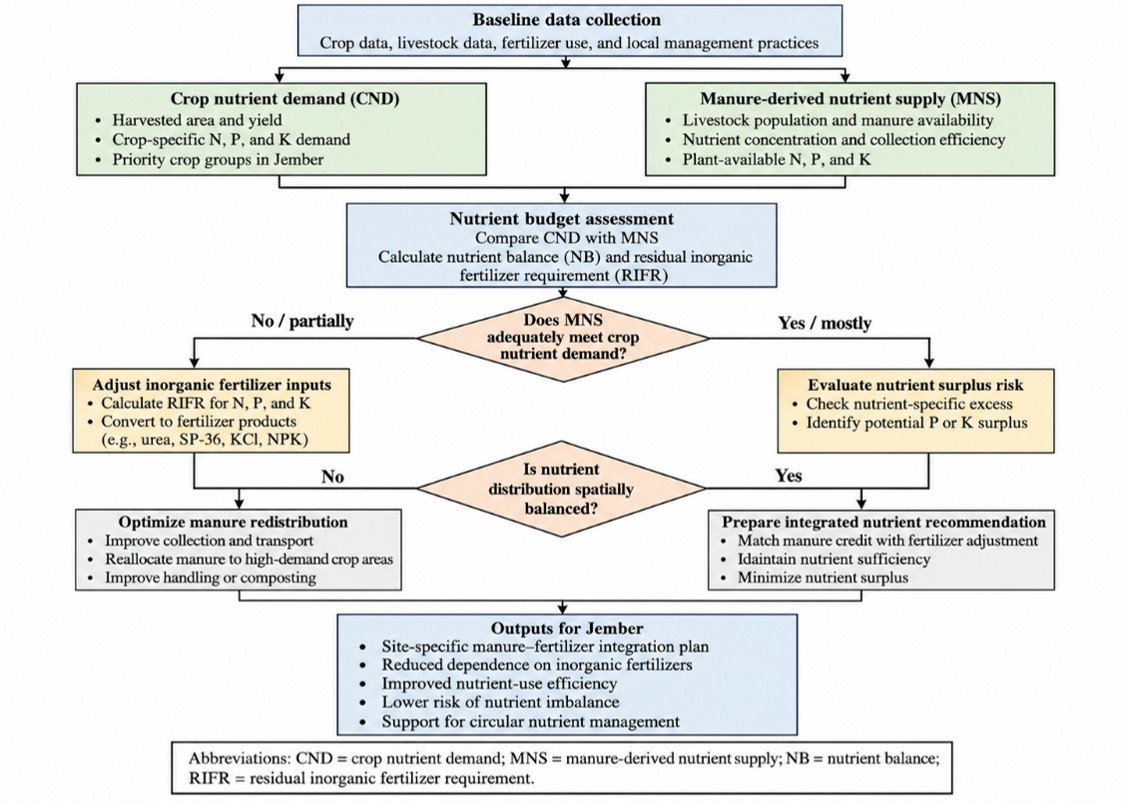
Regional integration of livestock manure into inorganic fertilizer planning requires explicit accounting of crop nutrient demand, manure recoverability, nutrient retention, and plant availability. This study developed a regional nutrient budget framework for Jember Regency, Indonesia, to estimate crop nutrient demand (CND), collectable livestock manure (LM), manure-derived nutrient supply (MNS), and residual inorganic fertilizer requirement (RIFR) for nitrogen (N), phosphorus (P), and potassium (K). Regional crop and livestock data were combined with crop-specific nutrient coefficients, manure excretion rates, dry matter fractions, collection efficiencies, nutrient concentrations, retention factors, and plant-availability coefficients. The selected crops required an estimated 32,478.0 Mg N, 5,770.8 Mg P, and 26,613.6 Mg K yr⁻¹. Collectable LM was estimated at 221,268.5 Mg dry matter yr⁻¹, providing approximately 1,087.0 Mg N, 775.5 Mg P, and 2,012.2 Mg K yr⁻¹ as plant-available nutrients. Crediting these nutrients produced estimated potential reductions in inorganic fertilizer requirement of approximately 3.35% for N, 13.44% for P, and 7.56% for K. Under the enhanced manure redistribution scenario, the modeled reductions increased to approximately 5.19% for N, 20.83% for P, and 11.72% for K. Sensitivity analysis identified crop nutrient requirement coefficients and target yield as the most influential crop-side parameters, while collection efficiency and plant availability were important manure-side determinants. The framework provides a transparent and reproducible basis for nutrient-specific regional fertilizer planning; however, the estimates should be interpreted as planning values rather than field-level fertilizer recommendations, with local implementation requiring additional soil, manure, spatial, and economic information.
References
Álvarez Salas, M., Sica, P., Rydgård, M., Sitzmann, T. J., Nyang’au, J. O., El Mahdi, J., Moshkin, E., de Castro e Silva, H. L., Chrysanthopoulos, S., Kopp, C., Wali, K., Zireeni, Y., Ural-Janssen, A., El Hajj Hassan, S., Kebalo, L. F., Chadwick, D., & Jensen, L. S. (2024). Current challenges on the widespread adoption of new bio-based fertilizers: insights to move forward toward more circular food systems [Review]. Frontiers in Sustainable Food Systems, Volume 8 - 2024. https://doi.org/10.3389/fsufs.2024.1386680
Apeh, C. C., Chiemela, S. N., Apeh, A. C., Okere, R. A., Ukwuaba, S. I., & Onyekuru, A. N. (2024). Analysis of Adoption of Soil Nutrient Management Practices: A Case of Rice Farmers in Liberia. Land Degradation & Development, 35(18), 5549-5558. https://doi.org/10.1002/ldr.5314
Bhattacharyya, S. S., Adeyemi, M. A., Onyeneke, R. U., Bhattacharyya, S., Faborode, H. F. B., Melchor-Martínez, E. M., Iqbal, H. M. N., & Parra-Saldívar, R. (2021). Nutrient Budgeting — A Robust Indicator of Soil–Water–Air Contamination Monitoring and Prevention. Environmental Technology & Innovation, 24, 101944. https://doi.org/10.1016/j.eti.2021.101944
Bohoussou, N. D. Y., Han, S.-W., Li, H.-R., Kouadio, Y. D., Ejaz, I., Virk, A. L., Dang, Y. P., Zhao, X., & Zhang, H.-L. (2023). Effects of fertilizer application strategies on soil organic carbon and total nitrogen storage under different agronomic practices: A meta-analysis. Land Degradation & Development, 34(18), 5889-5904. https://doi.org/10.1002/ldr.4885
Chen, Q., Xie, J., Li, L., Khan, K. S., Wang, L., Chang, L., & Du, C. (2025). Partial substitution of chemical fertilizer with organic fertilizer: a promising circular economy approach for improvement soil physical and chemical properties and sustainable crop yields [Original Research]. Frontiers in Plant Science, Volume 16 - 2025. https://doi.org/10.3389/fpls.2025.1565081
Dell, C. J., Baker, J. M., Spiegal, S., Porter, S. A., Leytem, A. B., Flynn, K. C., Rotz, C. A., Bjorneberg, D. L., Bryant, R. B., Hagevoort, G. R., Williamson, J. C., Slaughter, A., & Kleinman, P. J. A. (2022). Challenges and opportunities for manureshed management across U.S. dairy systems: Case studies from four regions. Journal of Environmental Quality, 51(4), 521-539. https://doi.org/10.1002/jeq2.20341
Feng, X., Smith, W., & VanderZaag, A. C. (2023). Dairy manure nutrient recovery reduces greenhouse gas emissions and transportation cost in a modeling study [Original Research]. Frontiers in Animal Science, Volume 4 - 2023. https://doi.org/10.3389/fanim.2023.1134817
Guejjoud, H., Curie, F., & Grosbois, C. (2025). Century-Long Analysis of Nitrogen and Phosphorus Surplus in French Agriculture: Trends and Drivers. Global Biogeochemical Cycles, 39(3), e2024GB008184. https://doi.org/10.1029/2024GB008184
Han, Z., Hou, H., Yao, X., Qian, X., & Zhou, M. (2024). Substituting Partial Chemical Fertilizers with Bio-Organic Fertilizers to Reduce Greenhouse Gas Emissions in Water-Saving Irrigated Rice Fields. Agronomy, 14(3), 544. https://doi.org/10.3390/agronomy14030544
Hou, J., Zhang, D., & Zhu, J. (2021). Nutrient accumulation from excessive nutrient surplus caused by shifting from rice monoculture to rice–crayfish rotation. Environmental Pollution, 271, 116367. https://doi.org/10.1016/j.envpol.2020.116367
Jayasinghe, S. L., Thomas, D. T., Anderson, J. P., Chen, C., & Macdonald, B. C. T. (2023). Global Application of Regenerative Agriculture: A Review of Definitions and Assessment Approaches. Sustainability, 15(22), 15941. https://doi.org/10.3390/su152215941
Kadam, R., Jo, S., Lee, J., Khanthong, K., Jang, H., & Park, J. (2024). A Review on the Anaerobic Co-Digestion of Livestock Manures in the Context of Sustainable Waste Management. Energies, 17(3), 546. https://doi.org/10.3390/en17030546
Li, W., Wang, K., Feng, T., Miao, P., Zheng, Z., Zhang, X., Zheng, W., Li, Z., & Zhai, B. (2024). Optimizing combination of chemical nitrogen fertilizer and manure can increase yield and economic benefits of dryland wheat while reduce environmental risks. European Journal of Agronomy, 159, 127272. https://doi.org/10.1016/j.eja.2024.127272
Li, Y., Zhang, Y., Li, X., Li, H., Dong, W., Qin, S., Liu, X., Zhang, L., Hu, C., He, H., Zheng, P., & Zhao, J. (2025). Planting Diversification Enhances Phosphorus Availability and Reshapes Fungal Community Structure in the Maize Rhizosphere. Agronomy, 15(8), 1993. https://doi.org/10.3390/agronomy15081993
Ma, D., Teng, W., Mo, Y.-T., Yi, B., Chen, W.-L., Pang, Y.-P., & Wang, L. (2024). Effects of nitrogen, phosphorus, and potassium fertilization on plant growth, element levels in plants and soil, and the relationships among nutrient concentrations, plant yield, and nutrient status in Erythropalum scandens (Blume). Journal of Plant Nutrition, 47(1), 82-96. https://doi.org/10.1080/01904167.2023.2262504
Mancho, C., Diez-Pascual, S., Alonso, J., Gil-Díaz, M., García-Gonzalo, P., & Lobo, M. C. (2023). Medium/Long-Term Efficiency of Struvite for Lettuce (Lactuca sativa L.) Production: Effect on Soil Quality. Horticulturae, 9(6), 645. https://doi.org/10.3390/horticulturae9060645
Maurya, P., Goswami, M., Nautiyal, S., Prakash, S., Gupta, A. K., & Sathish, A. (2024). Resource Flow in Peri-urban Agroecosystem: an Assessment from Circular Economy Perspective. Circular Economy and Sustainability, 4(2), 1093-1114. 10.1007/s43615-023-00311-z
Muntwyler, A., Lugato, E., Panagos, P., Scherer, L., Muller, A., & Pfister, S. (2026). Modeling Organic Agriculture Expansion in the EU: Assessing Productivity and Environmental Trade-Offs. Global Change Biology, 32(7), e70973. https://doi.org/10.1111/gcb.70973
Oyedun, A. O., Salami, H. A., Odewole, M. M., Lawal, L. O., Akpenpuun, T. D., & Adebayo, H. O. (2025). A review of emerging trends in circular manure management and the role of digital solutions. Journal of the Saudi Society of Agricultural Sciences, 24(4), 21. 10.1007/s44447-025-00029-4
Ren, F., Sun, N., Misselbrook, T., Wu, L., Xu, M., Zhang, F., & Xu, W. (2022). Responses of crop productivity and reactive nitrogen losses to the application of animal manure to China's main crops: A meta-analysis. Science of The Total Environment, 850, 158064. https://doi.org/10.1016/j.scitotenv.2022.158064
Singh, K., Singh, R., Nwosu, N. J., Omara, P., Sharma, L., Dunn, B. L., & Singh, H. (2025). Optimizing Nutrient Delivery in Agronomic Crops: A Review of Enhanced Efficiency Fertilizers. Journal of Plant Nutrition and Soil Science, 188(4), 570-584. https://doi.org/10.1002/jpln.12010
Sun, W., Ros, G. H., Zhu, Q., Xu, D., Hou, Y., & de Vries, W. (2025). Optimization of manure recycling and fertilizer use to meet crop nutrient demands and reduce nutrient losses, a case study in Quzhou, China. Agricultural Systems, 226, 104321. https://doi.org/10.1016/j.agsy.2025.104321
Tamagno, S., Eagle, A. J., McLellan, E. L., van Kessel, C., Linquist, B. A., Ladha, J. K., & Pittelkow, C. M. (2022). Quantifying N leaching losses as a function of N balance: A path to sustainable food supply chains. Agriculture, Ecosystems & Environment, 324, 107714. https://doi.org/10.1016/j.agee.2021.107714
Wavhal, N., Dhaka, P., Kaur, S., & Wakchaure, N. (2025). Manure Management in Dairy Cattle: Insights Into Regional Variability and Sustainable Approaches. Environmental Quality Management, 35(2), e70221. https://doi.org/10.1002/tqem.70221
Westerik, D., Hoffland, E., & Hijbeek, R. (2024). Nitrogen fertilizer replacement values of organic amendments: determination and prediction. Nutrient Cycling in Agroecosystems, 129(3), 445-458. 10.1007/s10705-023-10316-7
Wu, G., Yang, S., Luan, C.-s., Wu, Q., Lin, L.-l., Li, X.-x., Che, Z., Zhou, D.-b., Dong, Z.-r., & Song, H. (2024). Partial organic substitution for synthetic fertilizer improves soil fertility and crop yields while mitigating N2O emissions in wheat-maize rotation system. European Journal of Agronomy, 154, 127077. https://doi.org/10.1016/j.eja.2023.127077
Xu, K., Zhang, Q.-Q., Cai, Y.-Y., Luo, X.-J., Zhai, Y.-Q., Liu, W.-R., & Ying, G.-G. (2026). Diagnosing spatial decoupling of manure and crop nutrients in China: drivers and multi-objective optimization for sustainable redistribution. npj Sustainable Agriculture, 4(1), 11. 10.1038/s44264-025-00120-x
Yu, X., Zhao, L., Yao, Z., Zhao, Y., Yu, J., Feng, J., Luo, J., Luo, L., & Huo, L. (2024). Methodological study on carbon sequestration accounting for emission reductions from the whole-chain utilization of livestock and poultry manure. Environmental Research, 263, 120269. https://doi.org/10.1016/j.envres.2024.120269
Zhang, X., Zou, T., Lassaletta, L., Mueller, N. D., Tubiello, F. N., Lisk, M. D., Lu, C., Conant, R. T., Dorich, C. D., Gerber, J., Tian, H., Bruulsema, T., Maaz, T. M., Nishina, K., Bodirsky, B. L., Popp, A., Bouwman, L., Beusen, A., Chang, J., Havlík, P., Leclère, D., Canadell, J. G., Jackson, R. B., Heffer, P., Wanner, N., Zhang, W., & Davidson, E. A. (2021). Quantification of global and national nitrogen budgets for crop production. Nature Food, 2(7), 529-540. 10.1038/s43016-021-00318-5
Zingore, S., Adolwa, I. S., Njoroge, S., Johnson, J.-M., Saito, K., Phillips, S., Kihara, J., Mutegi, J., Murell, S., Dutta, S., Chivenge, P., Amouzou, K. A., Oberthur, T., Chakraborty, S., & Sileshi, G. W. (2022). Novel insights into factors associated with yield response and nutrient use efficiency of maize and rice in sub-Saharan Africa. A review. Agronomy for Sustainable Development, 42(5), 82. 10.1007/s13593-022-00821-4
Downloads
Additional Files
Published
How to Cite
Issue
Section
License
Copyright (c) 2026 Adi Septa Hidayat, Wulan Triminarwati, Ratmi Rosilawati

This work is licensed under a Creative Commons Attribution-NonCommercial-ShareAlike 4.0 International License.
Authors retain copyright and grant the journal right of first publication with the work simultaneously licensed under a Creative Commons Attribution License that allows others to share the work with an acknowledgement of the work's authorship and initial publication in this journal.
Authors are able to enter into separate, additional contractual arrangements for the non-exclusive distribution of the journal's published version of the work (e.g., post it to an institutional repository or publish it in a book), with an acknowledgement of its initial publication in this journal.
Authors are permitted and encouraged to post their work online (e.g., in institutional repositories or on their website) prior to and during the submission process, as it can lead to productive exchanges, as well as earlier and greater citation of published work