Growth and yield response of hypoma peanut to rice husk biochar rates under limited water availability
DOI:
https://doi.org/10.31102/eam.3.2.109-122Keywords:
Dry cultivation, hypoma variety, limited water availability, rice husk biochar, soil amendmentAbstract
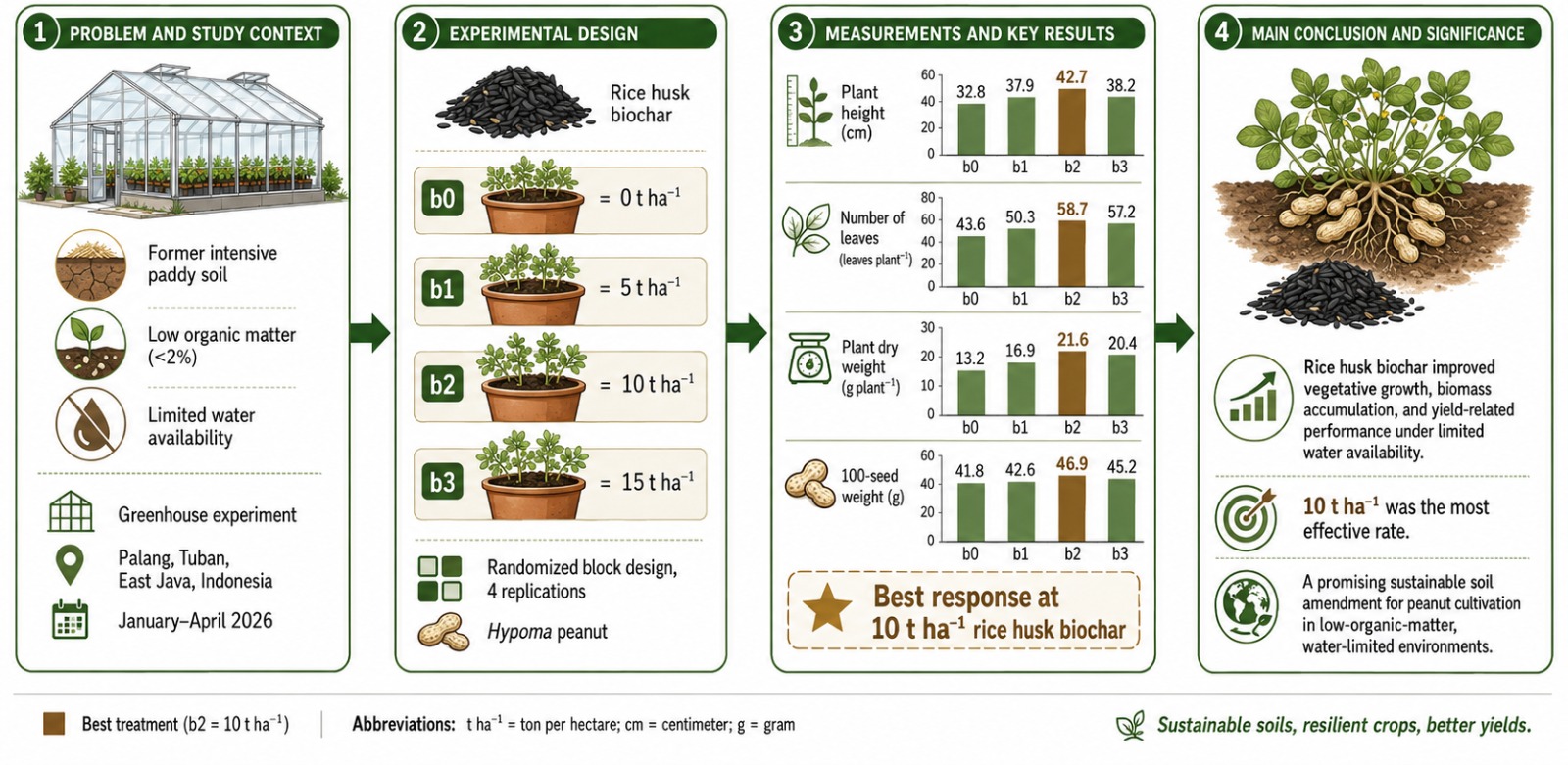
Limited water availability and low soil organic matter constrain peanut productivity in former intensive paddy soils, requiring locally available soil amendments that can improve crop performance during dry cultivation periods. This study aimed to evaluate the growth and yield response of Hypoma peanut to different rice husk biochar rates under limited water availability. The experiment was conducted from January to April 2026 in a greenhouse located in Palang District, Tuban Regency, East Java, Indonesia. A randomized block design was used with four rice husk biochar rates, namely 0, 5, 10, and 15 t ha⁻¹, and four replications, resulting in 16 experimental units. Rice husk biochar was applied 10 days before planting, while plant height, number of leaves, plant dry weight, and 100-seed weight were measured at 56 days after planting and analyzed using analysis of variance followed by the least significant difference test at 5%. Rice husk biochar improved all observed growth and yield-related variables, with the strongest response generally obtained at 10 t ha⁻¹. This rate produced plant height of 42.7 cm, 58.7 leaves plant⁻¹, plant dry weight of 21.6 g plant⁻¹, and 100-seed weight of 46.9 g. Therefore, 10 t ha⁻¹ rice husk biochar was the most effective rate for improving Hypoma peanut performance under limited water availability. These findings support rice husk biochar as a sustainable soil amendment for peanut cultivation in water-limited, low-organic-matter soils.
References
Barus, J., Ernawati, R. E. R., Wardani, N., Pujiharti, Y., Suretno, N. D., & Slameto, S. (2023). Improvement in soil properties and soil water content due to the application of rice husk biochar and straw compost in tropical upland. International Journal of Recycling of Organic Waste in Agriculture, 12(1). https://doi.org/10.30486/IJROWA.2022.1942099.1355
Culas, R. J., Anwar, M. R., & Maraseni, T. N. (2025). A framework for evaluating benefits of organic fertilizer use in agriculture. Journal of Agriculture and Food Research, 19, 101576. https://doi.org/10.1016/j.jafr.2024.101576
Kabir, E., Kim, K.-H., & Kwon, E. E. (2023). Biochar as a tool for the improvement of soil and environment [Review]. Frontiers in Environmental Science, Volume 11 - 2023. https://doi.org/10.3389/fenvs.2023.1324533
Khan, S., Irshad, S., Mehmood, K., Hasnain, Z., Nawaz, M., Rais, A., Gul, S., Wahid, M. A., Hashem, A., & Abd_Allah, E. F. (2024). Biochar production and characteristics, its impacts on soil health, crop production, and yield enhancement: A review. Plants, 13(2), 166. https://doi.org/10.3390/plants13020166
Li, J., Peduruhewa, J. H., Brown, R. W., Chadwick, D. R., Griffiths, R. I., Fu, H., Bian, H., Sheng, L., Ma, Q., & Jones, D. L. (2026). Biochar reshapes soil bacterial community composition and survival strategies: a meta-analysis revealing trade-offs between microbial stability and functional complexity. Biology and Fertility of Soils, 62(2), 251-266. https://doi.org/10.1007/s00374-025-01971-9
Luan, C., He, W., Su, X., Wang, X., Bai, Y., & Wang, L. (2021). Effects of biochar on soil water and temperature, nutrients, and yield of maize/soybean and maize/peanut intercropping systems. International Agrophysics, 35(4), 365-373. https://doi.org/10.31545/intagr/144133
Murtaza, G., Ahmed, Z., Iqbal, R., & Deng, G. (2025). Biochar from agricultural waste as a strategic resource for promotion of crop growth and nutrient cycling of soil under drought and salinity stress conditions: a comprehensive review with context of climate change. Journal of Plant Nutrition, 48(11), 1832-1883. https://doi.org/10.1080/01904167.2025.2460769
Ndede, E. O., Kurebito, S., Idowu, O., Tokunari, T., & Jindo, K. (2022). The Potential of Biochar to Enhance the Water Retention Properties of Sandy Agricultural Soils. Agronomy, 12(2), 311. https://doi.org/10.3390/agronomy12020311
Nguyen, C. N., Chau, H.-W., Kumar, A., Chakraborty, A., & Muttil, N. (2024). Biochar Amendment in Green Roof Substrate: A Comprehensive Review of the Benefits, Performance, and Challenges. Applied Sciences, 14(16), 7421.
Pandian, K., Vijayakumar, S., Mustaffa, M. R. A. F., Subramanian, P., & Chitraputhirapillai, S. (2024). Biochar – a sustainable soil conditioner for improving soil health, crop production and environment under changing climate: a review [Review]. Frontiers in Soil Science, Volume 4 - 2024. https://doi.org/10.3389/fsoil.2024.1376159
Razzaghi, F., Obour, P. B., & Arthur, E. (2020). Does biochar improve soil water retention? A systematic review and meta-analysis. Geoderma, 361, 114055. https://doi.org/10.1016/j.geoderma.2019.114055
Sun, M., Fan, S., & Zhang, N. (2025). Effects of biochar combined with the application of plant ash and effective microorganisms on the soil in the vegetable facility. Scientific Reports, 15(1), 15824. https://doi.org/10.1038/s41598-025-98684-8
Suyanto, A., Indrawati, U. S. Y. V., Rosalina, S., & Kurniadi, E. (2025). Effect of Rice Husk Bioactive Compost Charcoal Application on the Agronomic Characteristics of Peanut (Arachis hypogaea L.) on Alluvial Soil. Jurnal Teknik Pertanian Lampung (Journal of Agricultural Engineering), 14(2), 372-379. https://doi.org/10.23960/jtep-l.v14i2.372-379
Tadele, H., Feyisa, T., Tsegaye, L., & Musie, S. (2026). Effects of biochar, vermicompost, and inorganic N-P nutrients on soil physical properties, maize growth, and yield, Northwest Ethiopia. Arid Land Research and Management, 40(3), 423-440. https://doi.org/10.1080/15324982.2026.2650741
Varela Milla, O., Rivera, E. B., Huang, W.-J., Chien, C., & Wang, Y.-M. (2013). Agronomic properties and characterization of rice husk and wood biochars and their effect on the growth of water spinach in a field test. Journal of soil science and plant nutrition, 13(2), 251-266. http://dx.doi.org/10.4067/S0718-95162013005000022
Zheng, J., Wang, S., Wang, R., Chen, Y., Siddique, K. H., Xia, G., & Chi, D. (2021). Ameliorative roles of biochar-based fertilizer on morpho-physiological traits, nutrient uptake and yield in peanut (Arachis hypogaea L.) under water stress. Agricultural Water Management, 257, 107129. https://doi.org/10.1016/j.agwat.2021.107129
Additional Files
Published
How to Cite
Issue
Section
License
Copyright (c) 2026 Nofal Dwi Baskara, Syafitri Dewi, Agus Pahrevi

This work is licensed under a Creative Commons Attribution-NonCommercial-ShareAlike 4.0 International License.
Authors retain copyright and grant the journal right of first publication with the work simultaneously licensed under a Creative Commons Attribution License that allows others to share the work with an acknowledgement of the work's authorship and initial publication in this journal.
Authors are able to enter into separate, additional contractual arrangements for the non-exclusive distribution of the journal's published version of the work (e.g., post it to an institutional repository or publish it in a book), with an acknowledgement of its initial publication in this journal.
Authors are permitted and encouraged to post their work online (e.g., in institutional repositories or on their website) prior to and during the submission process, as it can lead to productive exchanges, as well as earlier and greater citation of published work