Growth and yield responses of shallot (Allium cepa L.) to goat manure and ammonium sulfate fertilizer rates
DOI:
https://doi.org/10.31102/eam.3.2.123-134Keywords:
shallot, organic fertilizer, productivityAbstract
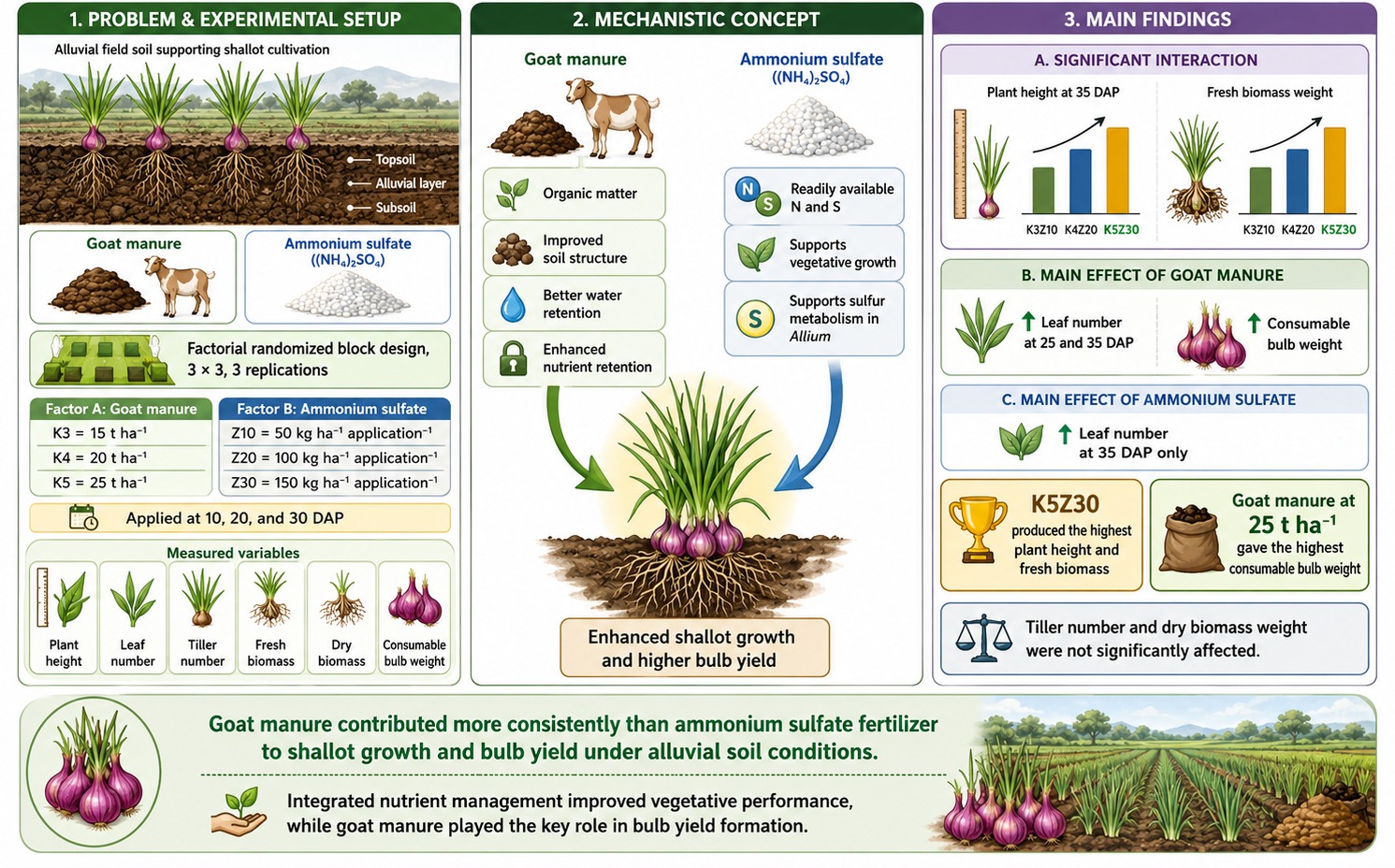
Balanced integration of organic and inorganic fertilizers is important for improving shallot productivity while maintaining soil fertility. This study evaluated the effects of goat manure and ammonium sulfate fertilizer rates on the growth and yield of shallot (Allium cepa L. Aggregatum Group) under alluvial soil conditions. A field experiment was conducted in Mlorah Village, Rejoso District, Nganjuk Regency, East Java, Indonesia, from April to June 2024 using a factorial randomized block design with three replications. Goat manure was applied at 3, 4, and 5 kg plot⁻¹ (15, 20, and 25 t ha⁻¹), while ammonium sulfate was applied at 10, 20, and 30 g plot⁻¹ application⁻¹ (50, 100, and 150 kg ha⁻¹ application⁻¹). Plant height, leaf number, tiller number, fresh and dry biomass weights, and consumable bulb weight were evaluated. Significant interactions between goat manure and ammonium sulfate were observed for plant height at 35 days after planting and fresh biomass weight. Goat manure independently increased leaf number at 25 and 35 days after planting and consumable bulb weight, whereas ammonium sulfate affected leaf number only at 35 days. Neither treatment significantly affected dry biomass weight or tiller number. The K5Z30 combination produced the highest plant height and fresh biomass weight, while 5 kg plot⁻¹ goat manure produced the highest consumable bulb weight. Overall, goat manure showed a more consistent contribution than ammonium sulfate to shallot growth and bulb yield under the tested alluvial soil conditions.
References
Ahmadi, F., Kallinger, D., Starzinger, A., & Lackner, M. (2024). Hemp (Cannabis salvia L.) Cultivation: Chemical Fertilizers or Organic Technologies, a Comprehensive Review. Nitrogen, 5(3), 624-654. https://doi.org/10.3390/nitrogen5030042
Aulakh, C. S., Sharma, S., Thakur, M., & Kaur, P. (2022). A review of the influences of organic farming on soil quality, crop productivity and produce quality. Journal of Plant Nutrition, 45(12), 1884-1905. https://doi.org/10.1080/01904167.2022.2027976
Firmanda, A., Fahma, F., Syamsu, K., Sari, Y. W., Suryanegara, L., Wood, K., & Saito, Y. (2023). Factors Influencing the Biodegradability of Agro-biopolymer Based Slow or Controlled Release Fertilizer. Journal of Polymers and the Environment, 31(5), 1706-1724. 10.1007/s10924-022-02718-5
Gelaye, Y., & Mengistu, A. (2025). Farmyard manure and nitrogen‒phosphorus‒sulfur fertilizers improve the yield of onion (Allium cepa L.) crop: A review article. Crop, Forage & Turfgrass Management, 11(2), e70064. https://doi.org/10.1002/cft2.70064
Haryanta, D., & Widya, S. A. (2024). Liquid Organic Fertilizer (LOF) as a Waste Processing Strategy to Support Increasing Crop Production: a Review: Pupuk Organik Cair (POC) sebagai Strategi Pengolahan Limbah dalam Mendukung Peningkatan Produksi Tanaman: sebuah Ulasan. Journal of Applied Plant Technology, 3(2), 106-119. https://doi.org/10.30742/65vpgp22
Ilmiah, M., Anggarani, M. A., & Mahfudhah, D. N. (2023). Literature Review of Antioxidant Activity of Several Types of Onions and Its Potensial as Health Supplements. Indonesian Journal of Chemical Science, 12(1), 103-111. https://doi.org/10.15294/ijcs.v12i1.57689
Martelli, R., Ali, A., Rondelli, V., & Barbanti, L. (2025). Are We Up to the Best Practices in Forage and Grassland Precision Harvest? A Review. Grass and Forage Science, 80(1), e12701. https://doi.org/10.1111/gfs.12701
Moldovan, C., Frumuzachi, O., Babotă, M., Barros, L., Mocan, A., Carradori, S., & Crişan, G. (2022). Therapeutic Uses and Pharmacological Properties of Shallot (Allium ascalonicum): A Systematic Review [Review]. Frontiers in Nutrition, Volume 9 - 2022. https://doi.org/10.3389/fnut.2022.903686
Paramesh, V., Mohan Kumar, R., Rajanna, G. A., Gowda, S., Nath, A. J., Madival, Y., Jinger, D., Bhat, S., & Toraskar, S. (2023). Integrated nutrient management for improving crop yields, soil properties, and reducing greenhouse gas emissions [Review]. Frontiers in Sustainable Food Systems, Volume 7 - 2023. https://doi.org/10.3389/fsufs.2023.1173258
Prabawati, S., Widayanti, S. M., Sulistyaningrum, A., Setyadjit, S., Arif, A. B., Winarti, C., Jamal, I. B., Munarso, S. J., Waryat, W., Budiyanto, A., & Risfaheri, R. (2026). Physiology, Nutrition, and Postharvest Technology on Shallots (Allium cepa L. aggregatum): A Review. Scientifica, 2026(1), 8328535. https://doi.org/10.1155/sci5/8328535
Qin, S., Wang, K., Gao, F., Ge, B., Cui, H., & Li, W. (2023). Biotechnologies for bulk production of microalgal biomass: from mass cultivation to dried biomass acquisition. Biotechnology for Biofuels and Bioproducts, 16(1), 131. 10.1186/s13068-023-02382-4
Sagar, N. A., Pareek, S., Benkeblia, N., & Xiao, J. (2022). Onion (Allium cepa L.) bioactives: Chemistry, pharmacotherapeutic functions, and industrial applications. Food Frontiers, 3(3), 380-412. https://doi.org/10.1002/fft2.135
Vigneault, P., Lafond-Lapalme, J., Deshaies, A., Khun, K., de la Sablonnière, S., Filion, M., Longchamps, L., & Mimee, B. (2024). An integrated data-driven approach to monitor and estimate plant-scale growth using UAV. ISPRS Open Journal of Photogrammetry and Remote Sensing, 11, 100052. https://doi.org/10.1016/j.ophoto.2023.100052
Additional Files
Published
How to Cite
Issue
Section
License
Copyright (c) 2026 Nugraheni Hadiyanti, Gita Maulina, Edy Kustiani

This work is licensed under a Creative Commons Attribution-NonCommercial-ShareAlike 4.0 International License.
Authors retain copyright and grant the journal right of first publication with the work simultaneously licensed under a Creative Commons Attribution License that allows others to share the work with an acknowledgement of the work's authorship and initial publication in this journal.
Authors are able to enter into separate, additional contractual arrangements for the non-exclusive distribution of the journal's published version of the work (e.g., post it to an institutional repository or publish it in a book), with an acknowledgement of its initial publication in this journal.
Authors are permitted and encouraged to post their work online (e.g., in institutional repositories or on their website) prior to and during the submission process, as it can lead to productive exchanges, as well as earlier and greater citation of published work