Soil nutrient availability and nutrient uptake by cocoa plants based on leaf nutrient content under various fertilizer application methods
DOI:
https://doi.org/10.31102/eam.3.2.92-108Keywords:
cocoa, fertilizer application methods, soil nutrients, leaf nutrient contentAbstract
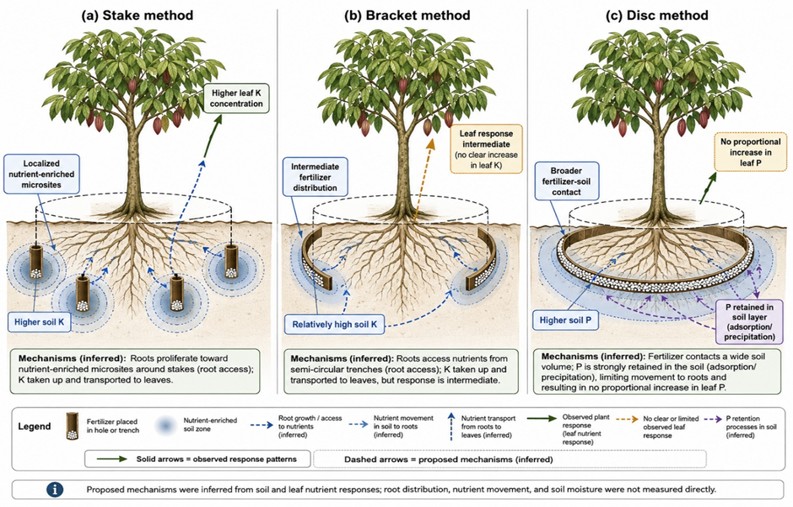
This study aims to evaluate the effects of various fertilizer application methods on soil nutrient availability and nutrient uptake by cocoa plants, as indicated by leaf nutrient content. The study was conducted in Lawe Sagu Hulu Village, Lawe Bulan Subdistrict, Southeast Aceh Regency, from February 2 to April 2, 2024. The research design employed a non-factorial Split-Plot Design (SPD) with fertilizer application treatments including the stake, furrow, and disc methods. The observed parameters included soil nitrogen (N), phosphorus (P), and potassium (K) content, as well as cocoa leaf N, P, and K content before and after treatment. The results showed that fertilizer application methods produced different responses regarding soil nutrient availability and cocoa leaf nutrient content. The disc method showed the highest increase in soil phosphorus availability, while the hole-planting technique tended to yield higher leaf nutrient content compared to the other methods. These findings indicate that the effectiveness of fertilizer application methods plays a crucial role in enhancing the efficiency of nutrient uptake by cocoa plants.
References
Espinoza Herrera, R., Vásquez Vásquez, S. S., Seco Granja, F., Molina-Müller, M. L., Capa-Morocho, M., & Cusquillo Guamán, A. L. (2022). Interacción de nitrógeno, fósforo y potasio sobre características del suelo, crecimiento y calidad de brotes y frutos de cacao en la Amazonía Ecuatoriana. Bioagro-, 34(3), 277–288. https://doi.org/10.51372/bioagro343.7
Meyer zu Drewer, J., Köster, M., Abdulai, I., Rötter, R. P., Hagemann, N., & Schmidt, H.-P. (2022). Impact of Different Methods of Root-Zone Application of Biochar-Based Fertilizers on Young Cocoa Plants: Insights from a Pot-Trial. Horticulturae, 8(4), 328. https://doi.org/10.3390/horticulturae8040328
Meza-Calderón, M. A., Moya-Menjívar, X. M., Parada-Berríos, F. A., & Vásquez-Osegueda, E. A. (2019). Nutrición de portainjertos de cacao (Theobroma Cacao L.) utilizando diferentes dosis de fórmula 15-15-15 y su influencia en el prendimiento de cuatro tipos de injerto: 2(1), 63–78. https://minerva.sic.ues.edu.sv/index.php/Minerva/article/download/27/44
Murillo Castillo, R. G., Piedra Marín, G., & Leon, R. G. (2013). Absorción de nutrientes a través de la hoja. Uniciencia, 27(1), 232–244. https://dialnet.unirioja.es/servlet/articulo?codigo=4945327
Mutaqin, Z., Pratiwi, S. N., Yunita, T. R., Yama, D. I., & Solihin, E. (2025). Efektivitas Beberapa Jenis Pupuk Nitrogen pada Pembibitan Tanaman Kakao (Theobroma cacao L.). Jurnal Ilmiah Universitas Batanghari Jambi, 25(2), 1151. https://doi.org/10.33087/jiubj.v25i2.6108
Prado, R. de M., & Rozane, D. E. (2020). Leaf analysis as diagnostic tool for balanced fertilization in tropical fruits (pp. 131–143). Elsevier. https://doi.org/10.1016/B978-0-12-818732-6.00011-3
Puentes-Páramo, Y. J., Menjivar-Flores, J. C., & Aranzazu-Hernández, F. (2014). Eficiencias en el uso de nitrógeno, fósforo y potasio en clones de cacao (Theobroma cacao L.). 26(2), 99–106. http://ve.scielo.org/pdf/ba/v26n2/art04.pdf
Puspita, V. A., Hamakonda, U. A., Taus, I., & Lea, V. C. (2024). Pelatihan Teknis Budidaya Kakao Guna Peningkatan Produktivitas di Kelurahan Tanah Rata, Kecamatan Kota Komba, Kabupaten Manggarai Timur. Abdi Unisap, 2(2), 321–327. https://doi.org/10.59632/abdiunisap.v2i2.334
Putri, Z., Lumbanraja, J., Novpriansyah, H., & Utomo, M. (2022). PENGARUH OLAH TANAH DAN PEMUPUKAN TERHADAP PERTUMBUHAN, PRODUKSI, DAN HARA TERANGKUT (C, N, P, K) TANAMAN KACANG HIJAU (Vigna radiata L.). Jurnal Agrotek Tropika, 10(1), 67–74. https://doi.org/10.23960/jat.v10i1.5631
Santosa, B. (2024). UJI BEBERAPA JENIS DAN DOSIS BAHAN ORGANIK TERHADAP PERTUMBUHAN BIBIT KAKAO (Theobroma cacao L.). Jurnal Embrio, 16(1), 59. https://doi.org/10.31317/embrio.v16i1.1033
Sitorus, U. K. P., Siagian, B., & Rahmawati, N. (2014). Respons pertumbuhan bibit kakao (Theobroma cacao L.) terhadap pemberian abu boiler dan pupuk urea pada media pembibitan. Jurnal Online Agroekoteknologi. ISSN No, 2337, 6597.
Sutarta, E. S., & Winarna, M. A. Y. Distribusi Hara Dalam Tanah Dan Produksi Akar Tanaman Kelapa Sawit Pada Metode Pemupukan Yang Berbeda. Jurnal Pertanian Tropik E-ISSN No, 2356, 4725.
Timor, P., Agusta, B., Tyasmoro, S. Y., & Sebayang, H. T. (2016). Respon pertumbuhan bibit kakao (Theobroma cacao L.) Pada berbagai jenis media tanam Jurnal Produksi Tanaman, Volume 4, Nomor 4, April 2016, hlm. 276 - 282.
Weinstein, M., Gräber, E. R., Yermiyahu, U., Sperling, O., Tsehansky, L., Elmakias, A., Grinshpun, J., Rosenfeld, L., & Baram, S. (2025). Nitrogen Affects Cacao (Theobroma cacao L.) Tree Growth, Macronutrient Demand, and Water Use. Journal of the American Society for Horticultural Science, 150(5), 290–299. https://doi.org/10.21273/jashs05518-25
Yazid, A. ., Mahyunis, M., Napitu, P. L. ., Simangunsong, S. ., Nurhamdi, M., Imran, A. ., & Nasution, N. M. . (2024). Perawatan Tanaman Kelapa Sawit Di Lahan Masyarakat Desa Bukit Cermin Hilir Kecamatan Dolok Masihul Kabupaten Serdang Bedagai. IRA Jurnal Pengabdian Kepada Masyarakat (IRAJPKM), 2(3), 130–137. https://doi.org/10.56862/irajpkm.v2i3.168
Additional Files
Published
How to Cite
Issue
Section
License
Copyright (c) 2026 Environmental and Agriculture Management

This work is licensed under a Creative Commons Attribution-NonCommercial-ShareAlike 4.0 International License.
Authors retain copyright and grant the journal right of first publication with the work simultaneously licensed under a Creative Commons Attribution License that allows others to share the work with an acknowledgement of the work's authorship and initial publication in this journal.
Authors are able to enter into separate, additional contractual arrangements for the non-exclusive distribution of the journal's published version of the work (e.g., post it to an institutional repository or publish it in a book), with an acknowledgement of its initial publication in this journal.
Authors are permitted and encouraged to post their work online (e.g., in institutional repositories or on their website) prior to and during the submission process, as it can lead to productive exchanges, as well as earlier and greater citation of published work