Optimization of early growth of bululawang sugarcane seedlings through arbuscular mycorrhizal dose application under greenhouse conditions
DOI:
https://doi.org/10.31102/eam.3.1.79-90Keywords:
bud-set seedlings, arbuscular mycorrhiza, early growth, sugarcaneAbstract
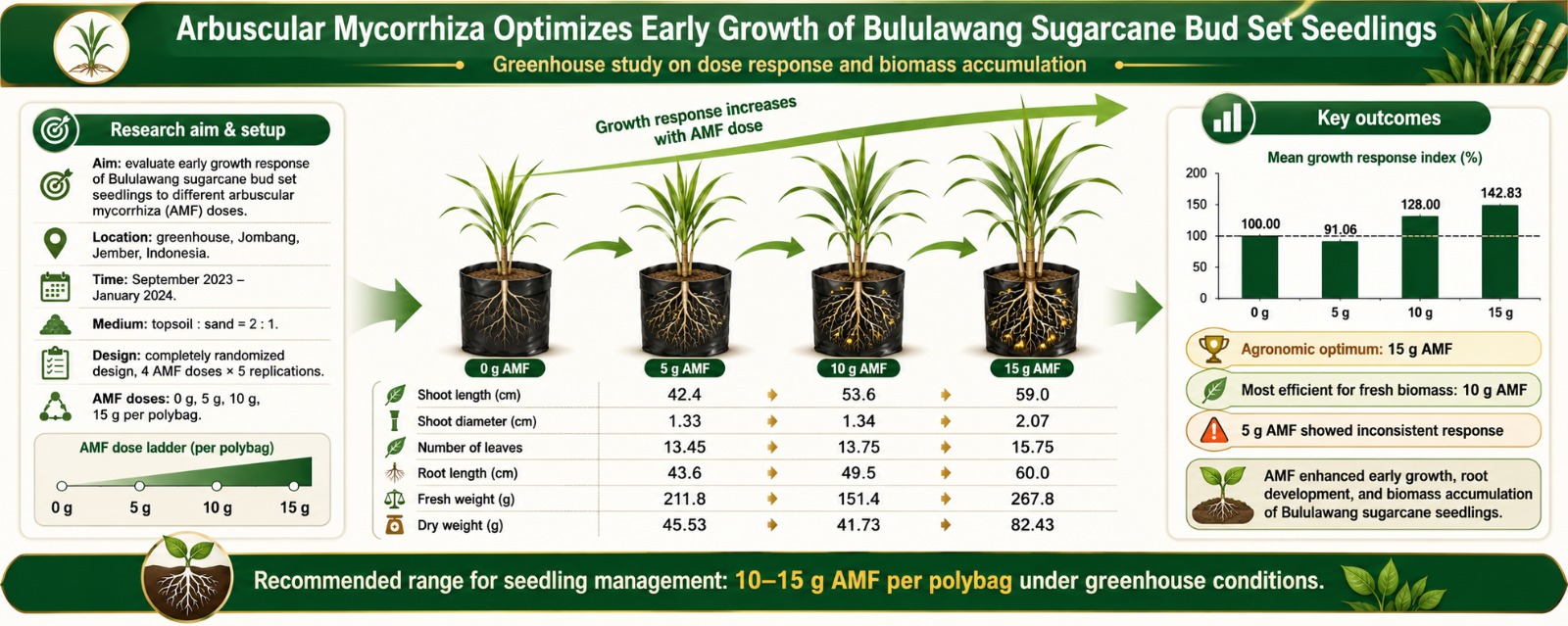
The early growth of Bululawang sugarcane bud-set seedlings requires seedling-production technology that can effectively and environmentally improve plant vigor. This study aimed to evaluate the early growth response of Bululawang sugarcane seedlings to different doses of arbuscular mycorrhizal fungi (AMF) under greenhouse conditions. The experiment was conducted from September 2023 to January 2024 using four AMF doses, namely 0 g, 5 g, 10 g, and 15 g per polybag, arranged in a Completely Randomized Design with five replications. The observed variables included shoot length, shoot diameter, number of leaves, root length, plant fresh weight, and plant dry weight. Data were analyzed using analysis of variance followed by Tukey’s honestly significant difference test at the 5% significance level. The mean growth response index was calculated by normalizing all measured growth and biomass variables against the 0 g control. AMF application produced different responses in shoot growth, root development, and biomass accumulation. The 10 g dose produced the highest fresh weight of 293.20 g, whereas the 15 g dose produced the highest dry weight of 82.43 g and the highest mean growth response index of 142.83%. Therefore, 15 g was considered the agronomically optimum dose because it produced the strongest overall growth and dry matter accumulation, while 10 g was considered an efficient dose because it maximized fresh biomass at a lower AMF input. AMF application has potential as a biological technology for improving Bululawang sugarcane seedling quality during early growth.
References
Amalyadi, R. (2026). Forage-based livestock systems, insectivorous birds, and veterinary ecology: integrative review. Environmental and Agriculture Management, 3(1), 1-22. doi:https://doi.org/10.31102/eam.3.1.23-46
Amalyadi, R., Karni, I., Aminurrahman, A., Septian, I. G. N., & Al Gifari, Z. (2025). Exploring the nutritional and functional potential of forage-based diets in poultry feeding systems: a systematic review toward sustainable avian nutrition. Environmental and Agriculture Management, 2(2), 87-103. doi:https://doi.org/10.31102/eam.2.2.87-103
Amalyadi, R., & Widiastuti, L. K. (2025). Gas-to-feed revolution: a novel review of the microbial conversion of industrial emissions into sustainable livestock feed. Environmental and Agriculture Management, 2(2), 104-121. doi:https://doi.org/10.31102/eam.2.2.104-121
Asadi, M., Rasouli, F., Amini, T., Hassanpouraghdam, M. B., Souri, S., Skrovankova, S., . . . Ercisli, S. (2022). Improvement of Photosynthetic Pigment Characteristics, Mineral Content, and Antioxidant Activity of Lettuce (Lactuca sativa L.) by Arbuscular Mycorrhizal Fungus and Seaweed Extract Foliar Application. Agronomy, 12(8), 1943. doi:https://doi.org/10.3390/agronomy12081943
Chafai, W., Haddioui, K., Serghini-Caid, H., Labazi, H., AlZain, M. N., Noman, O., . . . Khalid, A. (2023). Impact of Arbuscular mycorrhizal Fungal Strains Isolated from Soil on the Growth, Yield, and Fruit Quality of Tomato Plants under Different Fertilization Regimens. Horticulturae, 9(9), 973. doi:https://doi.org/10.3390/horticulturae9090973
Chen, D., Saeed, M., Ali, M. N., Raheel, M., Ashraf, W., Hassan, Z., . . . Negm, S. (2023). Plant Growth Promoting Rhizobacteria (PGPR) and Arbuscular Mycorrhizal Fungi Combined Application Reveals Enhanced Soil Fertility and Rice Production. Agronomy, 13(2), 550. doi:https://doi.org/10.3390/agronomy13020550
Chinnathambi, S., Peeran, M. F., Srinivasan, V., Sankar, S. M., & George, P. (2024). Optimizing mycorrhizal fungi application for improved nutrient uptake, growth, and disease resistance in cardamom seedlings (Elettaria cardamomum (L.) Maton). Heliyon, 10(20). doi:https://doi.org/10.1016/j.heliyon.2024.e39227
del Rosario, M.-H. M., Luis, S.-C. J., Lino, S.-S., Ricardo, S.-P., & Jabín, B.-B. J. (2022). Arbuscular Mycorrhizal Fungi: Inoculum Dose Affects Plant Development and Performance of Sugarcane (Saccharum spp.) Plantlets During Acclimatization Stage. Journal of Soil Science and Plant Nutrition, 22(4), 4847-4856. doi:10.1007/s42729-022-00964-z
Gomes Júnior, C. C., de Souza, R. P. B., Menezes, K. M. S., de Souza, A. H., Tomazeli-Silva, A., Valadares, S. V., . . . DaMatta, F. M. (2025). Boosting coffee seedling performance through arbuscular mycorrhizal association. Mycorrhiza, 35(6), 69. doi:https://doi.org/10.1007/s00572-025-01245-0
Huang, Q.-Q., Wang, S., Nong, Y.-J., Zhong, K.-M., Su, Y.-C., Qin, X.-J., . . . Li, Y.-R. (2026). Analysis of Arbuscular Mycorrhizal Fungal Community in Soil of Sugarcane at Different Tillage Depths. Sugar Tech. doi:https://doi.org/10.1007/s12355-026-01729-z
Juntahum, S., Ekprasert, J., & Boonlue, S. (2022). Efficiency of Arbuscular Mycorrhizal Fungi for the Growth Promotion of Sugarcane Under Pot Conditions. Sugar Tech, 24(6), 1738-1747. doi:10.1007/s12355-022-01129-z
Muharram, M., Samago, T. Y., & Garfansa, M. P. (2025). Improving soil acidity on peat soil through rice husk ash and rabbit urine biofertilizer application. Environmental and Agriculture Management, 2(2), 72-86. doi:https://doi.org/10.31102/eam.2.2.72-86
Peroni, P., Liu, Q., Lizarazu, W. Z., Xue, S., Yi, Z., Von Cossel, M., . . . Iqbal, Y. (2024). Biostimulant and Arbuscular Mycorrhizae Application on Four Major Biomass Crops as the Base of Phytomanagement Strategies in Metal-Contaminated Soils. Plants, 13(13), 1866. doi:https://doi.org/10.3390/plants13131866
Ramadhan, S. A., Putri, L. I., Novanto, P. R., Istiqomah, F. N., & Azhar, A. (2025). Effects of NPK Fertilizer and Arbuscular Mycorrhizal Fungi (AMF) on the Growth of Oil Palm (Elaeis guineensis Jacq.) Seedlings. PLANTA TROPIKA, 13(2), 208-218. doi:https://doi.org/10.18196/pt.v13i2.26091
Safahani, A., Mancinelli, R., Mohseni, B., & Radicetti, E. (2026). Synergistic Application of Biochar, Arbuscular Mycorrhizal Fungi, and Optimized Fertilization for Sustainable Sunflower Production in Semi-Arid Environments. Journal of Soil Science and Plant Nutrition, 26(1), 2219-2236. doi:10.1007/s42729-025-02992-x
Sun, W., & Shahrajabian, M. H. (2023). The Application of Arbuscular Mycorrhizal Fungi as Microbial Biostimulant, Sustainable Approaches in Modern Agriculture. Plants, 12(17), 3101. doi:https://doi.org/10.3390/plants12173101
Tripathi, M. K., Shukla, S. K., Jaiswal, V. P., Sharma, L., Nagargade, M., Pathak, A. D., . . . Ranka, A. (2025). Integration of Mycorrhizae, Azotobacter and Pseudomonas spp (PSB) with NPK and their Effects on Sugarcane Crop and Soil Health in Uttar Pradesh, India. Sugar Tech, 27(2), 340-356. doi:10.1007/s12355-024-01513-x
Wahab, A., Muhammad, M., Munir, A., Abdi, G., Zaman, W., Ayaz, A., . . . Reddy, S. P. (2023). Role of Arbuscular Mycorrhizal Fungi in Regulating Growth, Enhancing Productivity, and Potentially Influencing Ecosystems under Abiotic and Biotic Stresses. Plants, 12(17), 3102. doi:https://doi.org/10.3390/plants12173102
Additional Files
Published
How to Cite
Issue
Section
License
Copyright (c) 2026 Environmental and Agriculture Management

This work is licensed under a Creative Commons Attribution-NonCommercial-ShareAlike 4.0 International License.
Authors retain copyright and grant the journal right of first publication with the work simultaneously licensed under a Creative Commons Attribution License that allows others to share the work with an acknowledgement of the work's authorship and initial publication in this journal.
Authors are able to enter into separate, additional contractual arrangements for the non-exclusive distribution of the journal's published version of the work (e.g., post it to an institutional repository or publish it in a book), with an acknowledgement of its initial publication in this journal.
Authors are permitted and encouraged to post their work online (e.g., in institutional repositories or on their website) prior to and during the submission process, as it can lead to productive exchanges, as well as earlier and greater citation of published work