Integrated biofertilizer and inorganic fertilizer management for sustainable growth and yield improvement of hybrid maize (Zea mays L.)
DOI:
https://doi.org/10.31102/eam.3.1.67-78Keywords:
BISI-2 maize, biofertilizer, NPK fertilizer, PGPR, sustainable nutrient managementAbstract
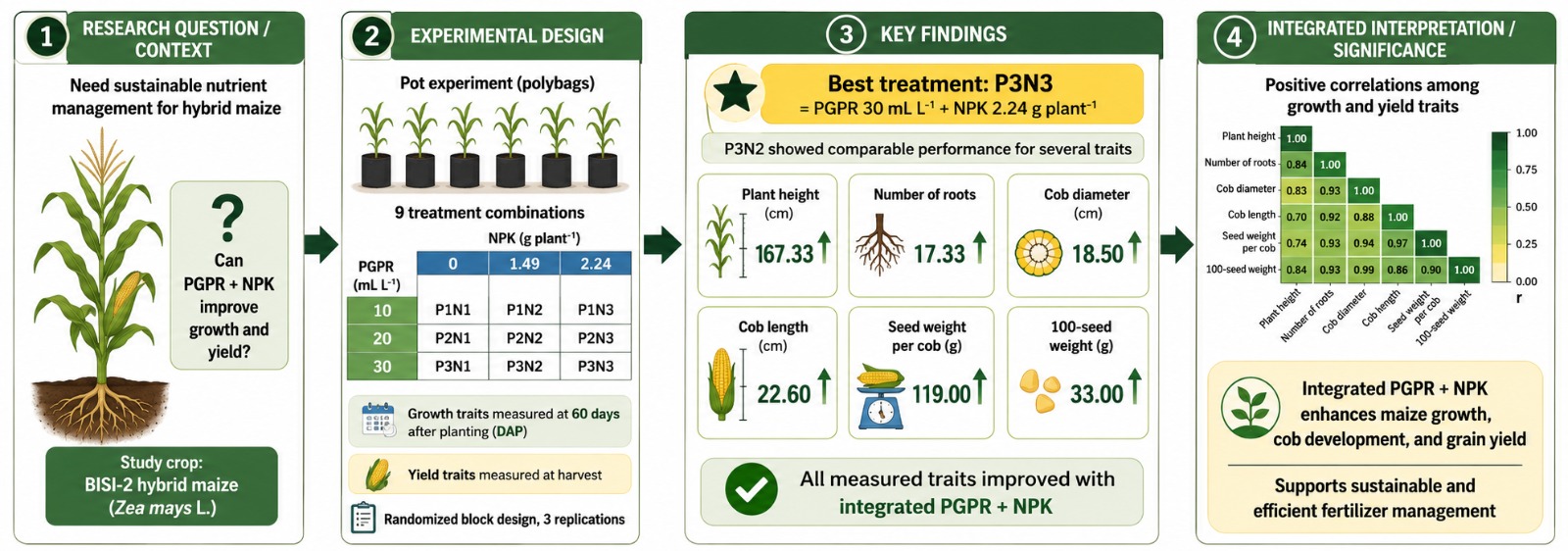
The increasing demand for maize production requires fertilization strategies that improve crop productivity while reducing excessive dependence on inorganic fertilizers. This study aimed to evaluate the effect of integrated plant growth-promoting rhizobacteria (PGPR) biofertilizer and NPK inorganic fertilizer management on the growth and yield improvement of BISI-2 hybrid maize. The experiment was conducted from July to October 2022 under polybag cultivation conditions in Proppo Village, Pamekasan Regency, East Java, Indonesia, using a randomized block design with nine PGPR–NPK treatment combinations and three replications. PGPR was applied at 10, 20, and 30 ml L⁻¹, while NPK fertilizer was applied at 0, 1.49, and 2.24 g plant⁻¹. Growth parameters, including plant height and root number, were observed at 60 days after planting, while yield parameters, including cob diameter, cob length, seed weight per cob, and 100-seed weight, were measured at harvest. Integrated PGPR and NPK fertilization improved all observed growth and yield parameters, with PGPR 30 ml L⁻¹ + NPK 2.24 g plant⁻¹ producing the highest values in most traits. Notably, PGPR 30 ml L⁻¹ + NPK 1.49 g plant⁻¹ showed statistically comparable performance in several parameters, suggesting that this combination may serve as an efficient fertilization option for maintaining maize performance while reducing inorganic fertilizer input. These findings support integrated PGPR–NPK management as a practical strategy for improving BISI-2 hybrid maize productivity and nutrient management efficiency.
References
Abbas, M., Tian, C., Nagy, M. K. I., Al-Metwally, M. S., Chen, X., & Abdel-Lattif, H. M. (2024). Synergistic Effect of Iron and Zinc Nanoparticles with Recommended Nitrogen Dose on Production and Grain Quality of Maize (Zea mays L.) Cultivars Under Drought Stress. Nitrogen, 5(4), 1156-1180. doi:https://doi.org/10.3390/nitrogen5040074
Ali, S., & Ali, A. (2025). Integrated Single Superphosphate with Cattle Manure Increased Growth, Yield, and Phosphorus Availability of Maize (Zea mays L.) Under Rainfed Conditions. Nitrogen, 6(1), 9. doi:https://doi.org/10.3390/nitrogen6010009
Behrouzi, D., Diyanat, M., Majidi, E., Mirhadi, M. J., & Shirkhani, A. (2023). Yield and quality of forage maize as a function of diverse irrigation regimes and biofertilizer in the west of Iran. Journal of Plant Nutrition, 46(10), 2246-2256. doi:https://doi.org/10.1080/01904167.2022.2155539
Bhaumik, S., Kashyap, R., & Ghosh Bag, A. (2024). Effect of essential plant nutrients on growth and yield of maize crop (Zea mays L.): a review. Vegetos, 37(5), 1705-1719. doi:https://doi.org/10.1007/s42535-024-01024-w
Chauhan, Z. Y., Shah, S. N., Patel, K. C., Shroff, J. C., & Patel, H. K. (2024). Optimizing integrated nutrient management for sustainable maize–sesame cropping in Gujarat Plains: A soil health perspective. Soil Science Society of America Journal, 88(3), 846-857. doi:https://doi.org/10.1002/saj2.20664
DahPahlavan, S., Farnia, A., Jafarzadeh Kenarsari, M., & Nakhjavan, S. (2023). Bio-organic and chemical integrated amendments; responses for corn growth (Zea mays L.) and nitrate accumulation. Cereal Research Communications, 51(4), 891-903. doi:https://doi.org/10.3390/plants13101331
Datul, E. (2026). Enhanced Yield of Green Corn Through Biofertilizer and Foliar Fertilizer Application in Double-Row Corn Planting Technology. International Journal of Sustainability and Advanced Integrated Research, 2(2), 636-641. doi:https://doi.org/10.65339/ijsair.V2.I2.231
de Moraes, V. C., Ruivo, L. B., Zeny, P. M., Barboza, L. E., Schiebelbein, L. M., Matiello, R. R., . . . Ohse, S. (2026). In field conditions the combined application of aqueous extracts from the cyanobacterium Arthrospira platensis (seeds) and the microalga Nannochloropsis oculata (foliar) enhanced the corn (Zea mays L.) yield. Journal of Applied Phycology, 38(1), 455-466. doi:https://doi.org/10.1007/s10811-025-03767-8
Dinar, D., Marina, I., Syamsiah, M., Umyati, S., & Sukmawati, D. (2026). Comparative Analysis of Integrated Crop Management (ICM) Implementation on Hybrid Maize Production and Farmers’ Income (Zea mays L.). Jurnal Penelitian Pendidikan IPA, 12(2), 731-737. doi:https://doi.org/10.29303/jppipa.v12i2.14306
El-Akhdar, I., Elhawat, N., Shabana, M. M. A., Aboelsoud, H. M., & Alshaal, T. (2025). Physiological and Agronomic Responses of Maize (Zea mays L.) to Compost and PGPR Under Different Salinity Levels. Plants, 14(10), 1539. doi:https://doi.org/10.3390/plants14101539
Imran. (2024). Integration of organic, inorganic and bio fertilizer, improve maize-wheat system productivity and soil nutrients. Journal of Plant Nutrition, 47(15), 2494-2510. doi:https://doi.org/10.1080/01904167.2024.2354190
Kakabouki, I., Roussis, I., Mavroeidis, A., Stavropoulos, P., Kanatas, P., Pantaleon, K., . . . Tigka, E. (2025). Effects of Zeolite Application and Inorganic Nitrogen Fertilization on Growth, Productivity, and Nitrogen and Water Use Efficiency of Maize (Zea mays L.) Cultivated Under Mediterranean Conditions. Sustainability, 17(5), 2178. doi:https://doi.org/10.3390/su17052178
Karimi, M., Sayfzadeh, S., Pazoki, A., Hadidi Masouleh, E., & Zakerin, H. R. (2025). Effects of bio-fertilizers and nitrogen levels on yield and quality of single-cross maize (KSC 704). Journal of Plant Nutrition, 48(12), 1987-2003. doi:https://doi.org/10.1080/01904167.2025.2462718
Kumar, A., Singh, R., Babu, S., Avasthe, R. K., Das, A., Pandey, A., . . . Rathore, S. S. (2024). Integrated organic nutrient management: a sustainable approach for cleaner maize (Zea mays L.) production in the Indian Himalayas. Organic Agriculture, 14(3), 373-393. doi:10.1007/s13165-024-00471-8
Kurt, P. O. (2025). Field-based evaluation of multi-strain PGPR to improve zea mays yield and soil nutrient dynamics in semi-arid of Türkiye. Scientific Reports, 15(1), 22553. doi:https://doi.org/10.1038/s41598-025-07643-w
Moradi, L., & Siosemardeh, A. (2025). Bio and chemical fertilizers integration supplemented by biostimulants a sustainable way to reduce chemical inputs in rainfed wheat systems. Scientific Reports, 15(1), 45264. doi:https://doi.org/10.1038/s41598-025-29783-9
Risman, R. D. S., Nonkhonman, C., & Sungthongwises, K. (2025). Integrating vermicompost, black soldier fly, and inorganic fertilizers enhances corn growth and yield. Heliyon, 11(1). doi:https://doi.org/10.1016/j.heliyon.2024.e41314
Sary, D. H., & Abd El-Aziz, M. E. (2025). Synthesis and characterization of nano-micronutrient fertilizer and its effect on nutrient availability and maize (Zea Mays L.) productivity in calcareous soils. Scientific Reports, 15(1), 25838. doi:https://doi.org/10.1038/s41598-025-11273-7
Additional Files
Published
How to Cite
Issue
Section
License
Copyright (c) 2026 Environmental and Agriculture Management

This work is licensed under a Creative Commons Attribution-NonCommercial-ShareAlike 4.0 International License.
Authors retain copyright and grant the journal right of first publication with the work simultaneously licensed under a Creative Commons Attribution License that allows others to share the work with an acknowledgement of the work's authorship and initial publication in this journal.
Authors are able to enter into separate, additional contractual arrangements for the non-exclusive distribution of the journal's published version of the work (e.g., post it to an institutional repository or publish it in a book), with an acknowledgement of its initial publication in this journal.
Authors are permitted and encouraged to post their work online (e.g., in institutional repositories or on their website) prior to and during the submission process, as it can lead to productive exchanges, as well as earlier and greater citation of published work